
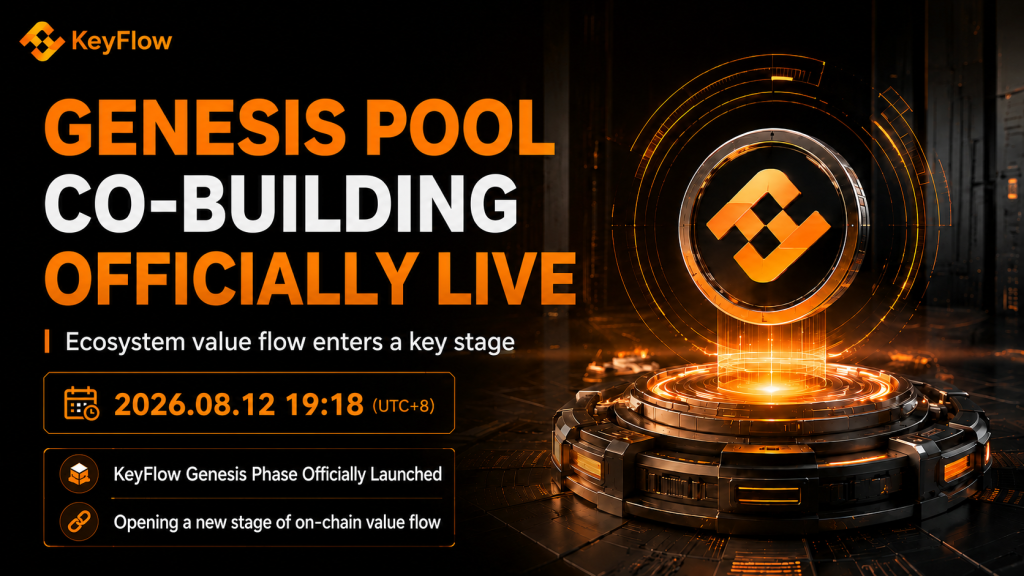
KeyFlow has officially launched its Genesis Pool Co-Building program, introducing a new framework that combines AI infrastructure, computing resources, blockchain settlement, and ecosystem liquidity.
The Genesis Pool opened at 19:18 on August 12, 2026, UTC+8. With the launch, KeyFlow introduced its early-bird conversion mechanism and 360-day Intelligent Computing LP Orders as the initial foundation of its liquidity strategy.
The project describes the initiative as an important step toward building an economic settlement network for the emerging AI Agent economy.
KeyFlow is built around a close relationship with UniKey. UniKey focuses on AI infrastructure and access to computing capabilities, while KeyFlow is designed to provide the settlement and value circulation layer.
The combined approach is intended to connect AI usage with an economic system capable of recording, settling, and circulating ecosystem value.
AI Adoption Is Driving Demand for Computing Power
Artificial intelligence is rapidly becoming part of the global digital economy.
Large language models are being integrated into applications, businesses are adopting AI automation, and AI Agents are becoming capable of completing increasingly complex tasks.
All of these developments depend on computing infrastructure.
An AI application may require access to several models. An Agent may need APIs, databases, and external tools. Businesses may require computing resources to operate AI systems at scale.
As adoption continues, computing power becomes an increasingly valuable resource.
However, advanced infrastructure can be costly and difficult for smaller developers and participants to access.
KeyFlow is attempting to address this challenge by creating an economic settlement framework around AI-related activity.
KeyFlow and UniKey Create a Two-Part Ecosystem
The ecosystem is structured around two complementary layers.
UniKey represents the AI capability layer.
KeyFlow represents the value settlement layer.
This structure allows the two platforms to focus on different parts of the same broader ecosystem.
UniKey Focuses on AI Capabilities
UniKey is positioned as a one-stop AI infrastructure platform for the Agent era.
It brings together AI models, computing resources, and workflow capabilities through a unified environment.
The objective is to make different AI resources easier for users and developers to access.
By creating a common infrastructure layer, UniKey can support applications that require multiple AI capabilities.
This makes it the technological foundation of the broader ecosystem.
KeyFlow Focuses on Value Circulation
KeyFlow operates on the economic side of the ecosystem.
Its framework is built around KEY and includes proposed mechanisms for token issuance, capital participation, liquidity management, revenue circulation, and market activity.
KeyFlow states that revenue generated through AI services, API calls, and computing-power leasing can contribute to its KEY buyback and burn system.
The goal is to connect AI activity with the economic mechanisms of the settlement network.
Genesis Pool Establishes the Initial Liquidity Base
The Genesis Pool is designed to provide the first major liquidity foundation for KeyFlow’s settlement network.
Participants contribute funds to the pool, and KeyFlow states that smart contracts convert these contributions into 360-day Intelligent Computing LP Orders.
The resulting orders are deposited into the ecosystem liquidity treasury.
The model is intended to provide longer-term liquidity while creating a structured participation mechanism for early users.
Participants should carefully review the platform’s terms, smart-contract information, and financial risks before contributing funds.
How the 360-Day LP Order Model Works
The Intelligent Computing LP Order operates over a stated 360-day period.
KeyFlow says its settlement process is linked to the blockchain’s block ledger.
Instead of releasing the full amount immediately, the mechanism is designed to settle progressively.
The platform states that generated principal and returns can support daily withdrawals according to the applicable rules.
Available amounts may also be re-entered into the ecosystem.
The intended result is a system that supports both ongoing liquidity and scheduled settlement.
Early-Bird Participants Receive Special Conversion Terms
KeyFlow has introduced an early-bird conversion system as part of the Genesis Pool.
Participants during the first day are stated to receive a 35% discount settlement price.
Based on the project’s stated formula, a 100 USDT contribution would correspond to approximately 153.8 USDT worth of KEY allocation.
The calculation is:
100 ÷ 0.65 ≈ 153.8
The early-bird mechanism is designed to provide an incentive for participants who join during the initial launch period.
Pricing Adjusts as the Program Progresses
The early-bird terms are not intended to remain unchanged.
KeyFlow states that the discount adjustment increases by 0.005 every 24 hours.
This produces a progressive step-up in settlement cost.
Participants who enter earlier receive the initial stated conversion conditions.
As the program advances, later participants encounter adjusted rates.
The model is designed to reward early participation while allowing the settlement structure to evolve over time.
Users should verify the current conversion terms directly through the platform before participating.
Routing Nodes Expand the Ecosystem
KeyFlow has introduced a routing-node structure alongside the Genesis Pool.
According to the project, users can activate an account as an active routing node with a 100 USDT contribution.
The routing system is intended to expand the network and support ecosystem collaboration.
Routing nodes can participate in promotional, distribution, and network-related activities associated with the computing-power ecosystem.
KeyFlow has also created three higher routing levels.
These levels are known as A1, A2, and A3.
A1 Routing Level
The A1 level is associated with a 1,000 USDT participation tier.
Participants who reach this threshold can qualify for A1 routing status.
KeyFlow describes this level as a basic service-provider node qualification.
Participants can participate in the network’s basic node structure and receive applicable referral revenue sharing under the project’s rules.
The A1 level provides a starting point for users seeking a more active network role.
A2 Routing Level
The A2 level is linked to a 5,000 USDT tier.
Participants reaching this amount can qualify for direct A2 routing status.
KeyFlow states that A2 participants receive expanded agency and distribution support related to computing-power tokens.
The tier also provides a more direct connection to the underlying computing-power monetization channel.
A3 Routing Level
The A3 level represents the highest announced routing tier.
Participants reaching 10,000 USDT can qualify for A3 routing status.
According to KeyFlow, A3 participants receive enhanced agency rights for computing-power tokens.
The project also states that this tier provides long-term revenue-sharing rights connected to 20% of network-wide SWAP fees.
These are platform-specific terms and should be evaluated carefully before participation.
KEY Serves as the Core Economic Asset
KEY is positioned as the central token within the KeyFlow ecosystem.
The project describes KEY as the connection between AI computing resources and application services.
The token is incorporated into the proposed framework for issuance, circulation, liquidity, revenue, and buyback and burn activity.
The objective is to create a relationship between ecosystem usage and token economics.
For such a model to become sustainable, the network will require genuine usage, continued adoption, adequate liquidity, and consistent execution.
Connecting AI Activity With Economic Settlement
KeyFlow’s broader concept revolves around the economic value generated by AI activity.
An AI Agent can consume computing resources while completing a task.
A developer may use an API to power an application.
A business may pay for AI services.
A computing provider may supply infrastructure.
Each activity creates demand for AI resources.
KeyFlow aims to establish a settlement framework around this demand.
UniKey supplies the capability layer, while KeyFlow handles the proposed value circulation layer.
Supporting the Growth of AI Agents
AI Agents are becoming one of the most important developments in the AI industry.
Unlike traditional applications, Agents can perform multiple actions and coordinate different services.
They can interact with APIs, use external tools, retrieve information, process data, and work with multiple AI models.
These capabilities require infrastructure.
As Agent adoption expands, demand for computing power and AI services may also increase.
KeyFlow is positioning its ecosystem around this developing market.
Building a Connected Network
KeyFlow’s long-term vision includes multiple categories of participants.
Developers can build AI applications.
Users can access AI services.
Computing providers can supply resources.
Routing nodes can support distribution.
Community partners can contribute to ecosystem growth.
Liquidity participants can help establish the settlement infrastructure.
The project seeks to connect these groups through a shared economic network.
The Role of the Genesis Liquidity Treasury
Liquidity is fundamental to many blockchain ecosystems.
It supports transactions and can help facilitate token exchanges and market activity.
KeyFlow’s Genesis Pool is designed to create the initial liquidity treasury for its settlement network.
The 360-day LP Order structure is intended to provide liquidity over an extended period.
This gives KeyFlow a foundation from which it can develop additional ecosystem functions.
The effectiveness of this strategy will ultimately depend on market demand, actual usage, liquidity, and long-term adoption.
AI and Blockchain Are Converging
The combination of AI and blockchain is creating new possibilities.
AI provides intelligence and automation.
Blockchain provides programmable transactions and token-based settlement.
Computing power connects the two technologies because AI systems require substantial infrastructure.
KeyFlow is attempting to use blockchain as an economic settlement layer around AI infrastructure.
Its relationship with UniKey provides the AI capability component, while KeyFlow focuses on economic circulation.
A New AI Value Cycle
KeyFlow’s ecosystem can be understood as a connected value cycle.
Users first access AI capabilities through UniKey.
Applications and Agents consume models, APIs, and computing resources.
This generates usage and economic activity.
KeyFlow then provides the proposed settlement infrastructure around that activity.
KEY serves as the central economic asset.
The project’s buyback and burn mechanism is intended to connect ecosystem revenue with token circulation.
The broader goal is to create a sustainable loop between AI usage and ecosystem value.
Why the Genesis Pool Matters
The Genesis Pool combines several parts of KeyFlow’s strategy into one launch.
It establishes a liquidity mechanism.
It introduces early-bird conversion terms.
It creates 360-day Intelligent Computing LP Orders.
It operates alongside the routing-node network.
It supports the project’s broader goal of developing an AI-focused settlement system.
For KeyFlow, the Genesis Pool therefore represents an important transition into its next phase of ecosystem development.
Creating More Opportunities for Participation
KeyFlow says its objective is to reduce some of the barriers to participating in the AI economy.
Advanced computing infrastructure can require significant resources.
Smaller developers may not have the capital needed to build large-scale AI systems.
Businesses can also face challenges when trying to access increasingly expensive computing resources.
KeyFlow’s model is designed to provide another way for participants to engage with the AI infrastructure economy.
Its long-term results will depend on actual adoption and sustained demand.
The Importance of Real AI Usage
For any AI-focused ecosystem to grow sustainably, real usage is critical.
Technology alone is not enough.
An ecosystem needs developers building applications, users consuming services, and businesses creating genuine demand.
Computing resources must also be useful and competitive.
KeyFlow’s future development will therefore depend on whether its settlement framework can support meaningful AI-related activity.
This makes ecosystem adoption an important factor to watch as the project develops.
KeyFlow’s Next Development Stage
The Genesis Pool marks the beginning of a new phase for KeyFlow.
The project now has a live participation framework that combines liquidity, token settlement, routing nodes, and AI infrastructure.
The next stage will focus on expanding the network and developing greater ecosystem activity.
Attracting developers, users, computing providers, and community partners will be important to the project’s future.
Transparent execution and sustainable network activity will also be essential.
Official Genesis Pool Launch
KeyFlow officially launched its Genesis Pool Co-Building program at 19:18 on August 12, 2026, UTC+8.
The launch introduced the early-bird conversion system and 360-day Intelligent Computing LP Orders.
It also expanded the project’s routing structure through the 100 USDT entry node and the A1, A2, and A3 participation tiers.
Together, these components create the initial framework for KeyFlow’s settlement ecosystem.
A Broader Vision for AI Economic Infrastructure
The AI industry is continuing to expand at a rapid pace.
As models become more capable and Agents become more autonomous, the need for computing power and supporting services is likely to remain significant.
This could create opportunities for platforms that can connect AI capabilities with efficient economic infrastructure.
KeyFlow is positioning itself within this opportunity.
UniKey provides the AI infrastructure.
KeyFlow provides the proposed settlement network.
The Genesis Pool establishes the initial liquidity base.
The routing system supports network expansion.
KEY connects the proposed economic model.
Looking Ahead
The future of the AI Agent economy will depend on more than powerful models.
It will require infrastructure capable of supporting applications at scale.
It will require computing resources, APIs, intelligent workflows, and economic systems that can handle growing demand.
KeyFlow is attempting to build part of that economic infrastructure.
The Genesis Pool is its latest step toward creating a settlement network designed around AI usage and computing resources.
Whether the model achieves its long-term objectives will depend on adoption, execution, transparency, market conditions, and genuine ecosystem demand.
Final Thoughts
KeyFlow’s Genesis Pool launch introduces a new stage in its effort to connect AI infrastructure with blockchain-based value settlement.
The early-bird conversion mechanism provides the initial participation incentive, while the 360-day Intelligent Computing LP Orders are designed to establish longer-term liquidity.
The routing-node framework provides another pathway for ecosystem expansion, with A1, A2, and A3 tiers offering different levels of participation.
At the center of the system is KEY, which KeyFlow positions as the link between AI computing resources and application services.
As the AI Agent economy continues to evolve, KeyFlow will seek to demonstrate how its infrastructure can support the growing demand for computing power and AI services.
The official KeyFlow DApp is available through https://www.getkeyflow.ai.
The Genesis Pool launch marks the beginning of a new phase in KeyFlow’s effort to develop an economic settlement network for the rapidly expanding AI ecosystem.

