
Legal research has always been known as a tedious task. From identifying a legal issue, choosing keywords to be used in databases, reviewing the results, and analysing the judgments and laws in such search results to determine which can be useful. While the traditional way to do legal research remains important, artificial intelligence (AI) tools are changing how Australian legal professionals approach such a task.
One of the pioneer AI legal tools available in the Australian digital market, CaseChat AI, brings natural-language legal research, case analysis, authority discovery and document analysis into one Australian legal research workspace.
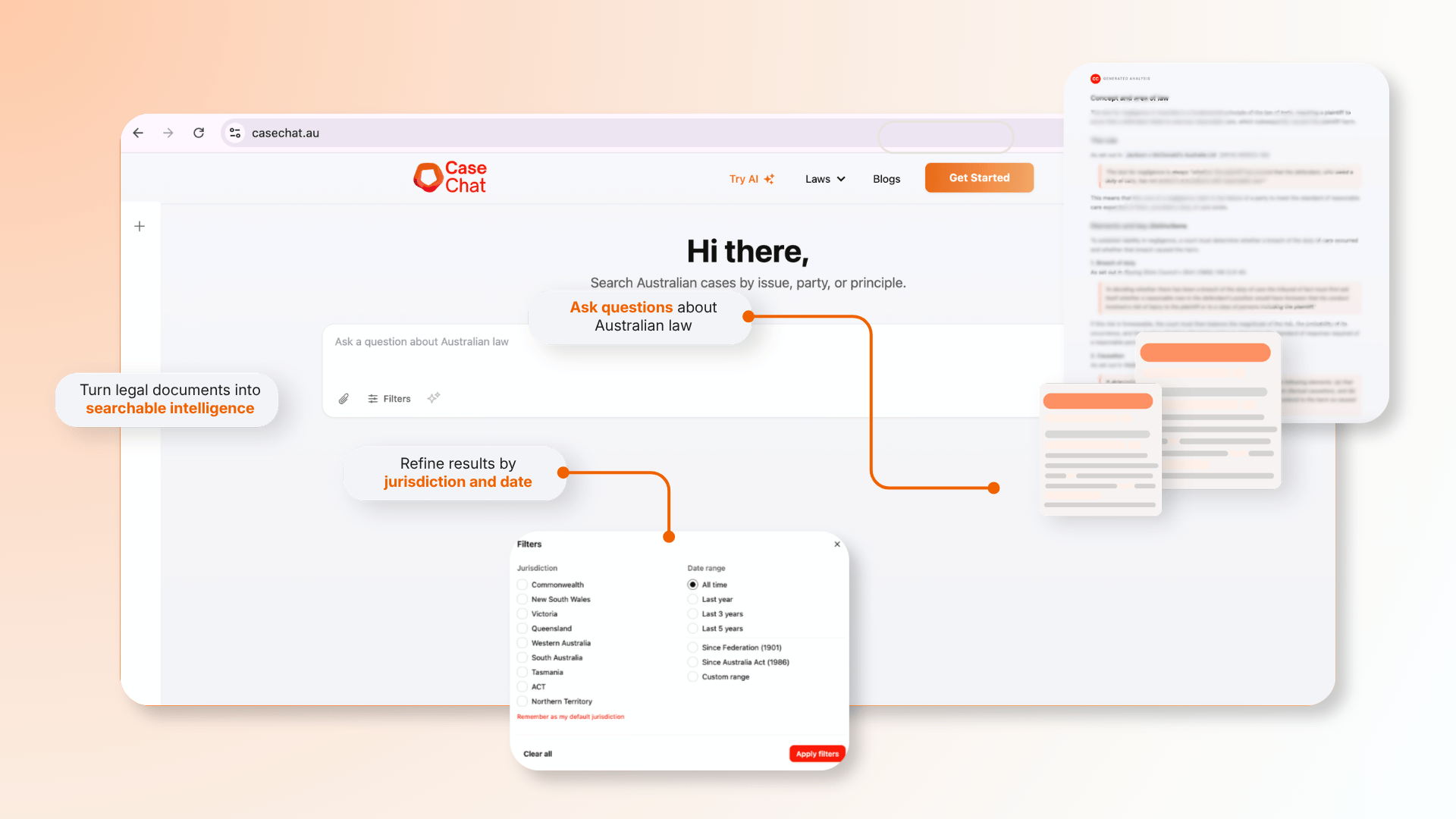
The most apparent feature for this legal tool is that it allows lawyers to ask their queries in plain, everyday language. This essential first step alone lessens the time needed to think of how to properly word legal questions to get accurate results.
It must be emphasised however that the results from CaseChat AI is not a replacement for legal research or professional judgment. Rather, it can only help legal professionals navigate large volumes of legal information & documents in order to move faster from an initial legal issue to relevant authorities that matter.
Legal Research Goes Beyond Finding Cases
CaseChat AI is not limited only to finding potentially relevant cases. It also provides for what the judgment actually is about, the legal principles applied, the reasoning behind such ruling, and how such a decision relates to other similar judgments.
For instance, you want to research “procedural fairness”. Numerous cases contain those exact words/phrases. As such, the AI tool of CaseChat is tasked next to determine which cases involve similar fact patterns, relevant legal principles, and applicable authorities. Another important feature is how these relevant legal principles are later on applied in future cases through the concept of precedent.
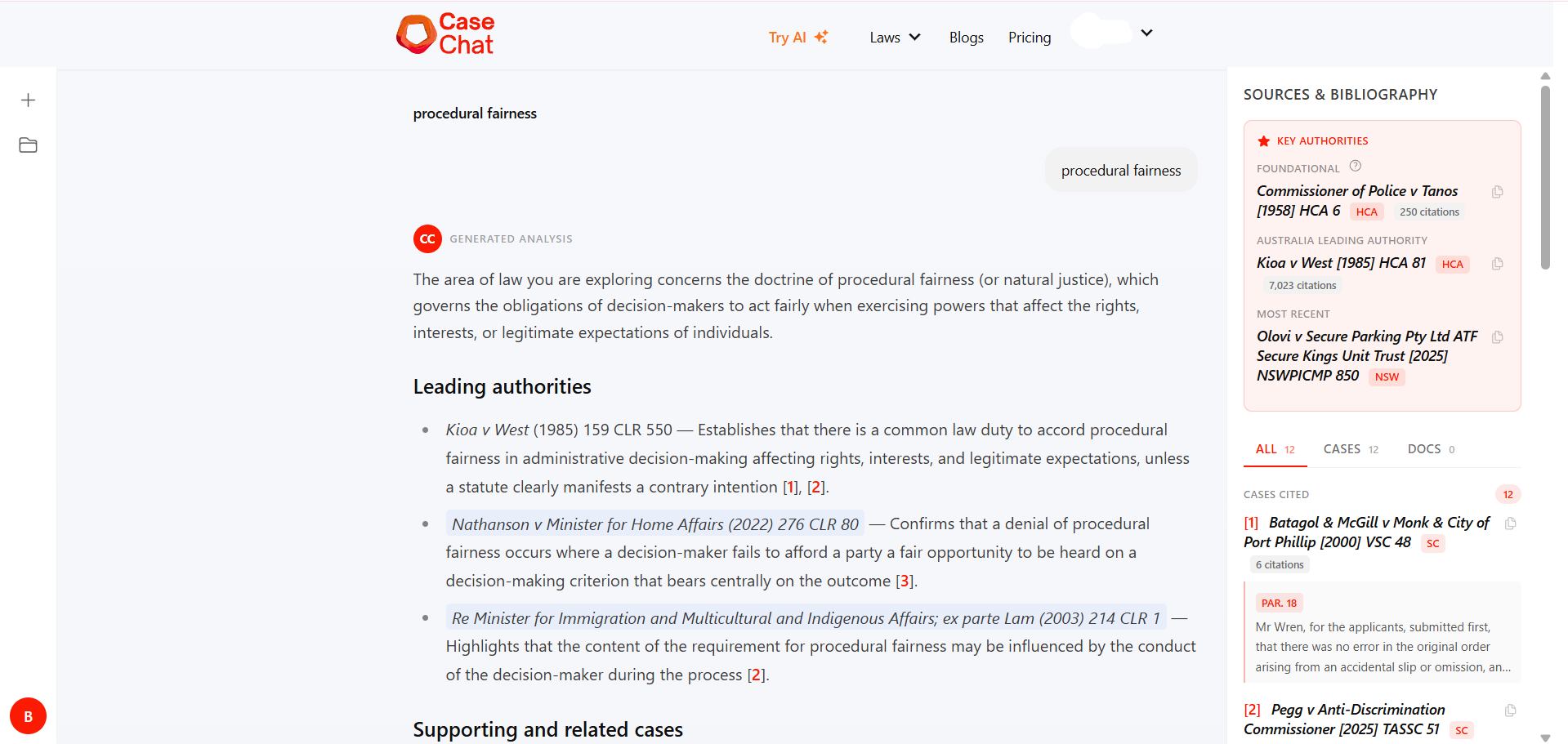
With the help of CaseChat AI’s legal tool, effective legal research thus can involve:
- Finding relevant cases and legislation;
- Reading and understanding judgments;
- Identifying legal issues and principles;
- Analysing judicial reasoning;
- Comparing relevant authorities;
- Tracing citations and related cases;
- Checking the underlying legal sources.
CaseChat AI can assist with all of these tasks so that legal professionals can devote more time applying legal judgment to the results using their logic.
CaseChat AI Brings Legal Research Into One Workflow
CaseChat AI, much like other AI legal tools in other countries, is designed to bring several stages of Australian legal research together in one, singular workflow.
Through this tool, lawyers can search legal authorities, ask questions about legal issues, analyse cases and documents, & explore related authorities without treating each task as a completely isolated research task.
As mentioned above, the workflow for legal research begins with a single legal issue. After which, a lawyer can use the resulting answer of CaseChat AI to identify potentially relevant cases and legislation. From there, the legal professionals can verify for themselves the authorities showed by the tool, examine the reasoning in particular judgments, and continue their legal research through the platform with follow-up questions.
Follow-questioning is one of the strengths of CaseChat AI due to its Key Follow-Ups feature. It helps legal professionals flow from the suggested research process — from an initial question rather than repeatedly starting new searches in order to finish the job efficiently.
Additionally, jurisdiction filtering can help researchers narrow results by Australian state, territory or court wherever relevant. This increases the credibility of your work by a mile.
AI Can Simplify Lengthy Australian Cases
Australian decisions can be lengthy and factually complex due to the multiple legal principles involved. Even before a legal professional can determine whether a case is relevant, they have to go through the text in full — facts, party arguments, applicable statutory provisions, precedent, ratio decidendi and orders.
This is where AI legal tools can make the full text more manageable to breeze through. CaseChat AI can analyse cases & provide summaries of important elements of a decision, including:
- Material facts;
- Evidence and relevant circumstances;
- Legal issues;
- Applicable legal principles;
- Judicial reasoning;
- Ratio decidendi;
- Obiter dicta;
- Decision and orders.
An AI-generated case summary, even from CaseChat AI should not be treated as a substitute for the text of the case itself. Remember that when there is legal material to be submitted, you, as a thinking legal professional, must examine & verify the underlying decision and determine what the court actually held & its implications.
AI Tools Can Analyse Legal Documents Too
CaseChat AI acknowledges the fact that the legal research process does not start from a vacuum. Legal research generally begins with a legal problem that arises from an existing document. As such, since legal professionals co-exist with multiple volumes of legal documents, analysing how they relate to relevant cases or laws can be another tedious part of legal work.
CaseChat AI has a feature built specifically for that. It includes document analysis and Q&A where users are given the ability to upload legal documents in the format of PDFs and clarify their contents.
For instance, a lawyer could use AI to identify key issues in a document, summarise its contents or ask specific questions about particular sections. The document can then be considered alongside broader legal research.
The Fresh Eyes Check feature of CaseChat AI aims to provide another perspective on uploaded legal documents and their analysis. This can help users identify issues or considerations that need further legal attention.
This feature expands legal AI tools’ roles beyond finding cases. It confirms that AI legal tools become part of a broader workflow involving both authoritative legal materials and the legal professional’s own materials.
CaseChat AI and the Future of Legal Research
The technological shift towards AI-assisted legal research does not mean that lawyers have to abandon traditional research skills. In fact, CaseChat AI emphasises the need to employ human verification skills alongside AI features.
It must be remember that while legal AI tools can assist with information discovery and analysis, lawyers remain responsible for deciding which authorities are relevant and how they should be applied.
Conclusion
CaseChat AI combines natural-language legal research with an Australian legal database, case analysis, citation tracking, document analysis and source verification. This makes moving between asking the AI tool everyday legal questions and understanding decisions to verifying the underlying resources within one research framework.
As AI becomes increasingly integrated into legal practice, research becomes less about searching for isolated cases & laws but more about exploring relations between legal issues, cases, legislation and legal principles.
For Australian legal professionals, there is an even bigger opportunity presented by AI: not replacing legal judgment, but assisting legal professionals navigate, understand and connect large amounts of legal information more efficiently.
Explore how CaseChat AI can support Australian legal research with case discovery, case analysis, authority verification and document analysis in one workflow.

