
Maniformer | November 2026
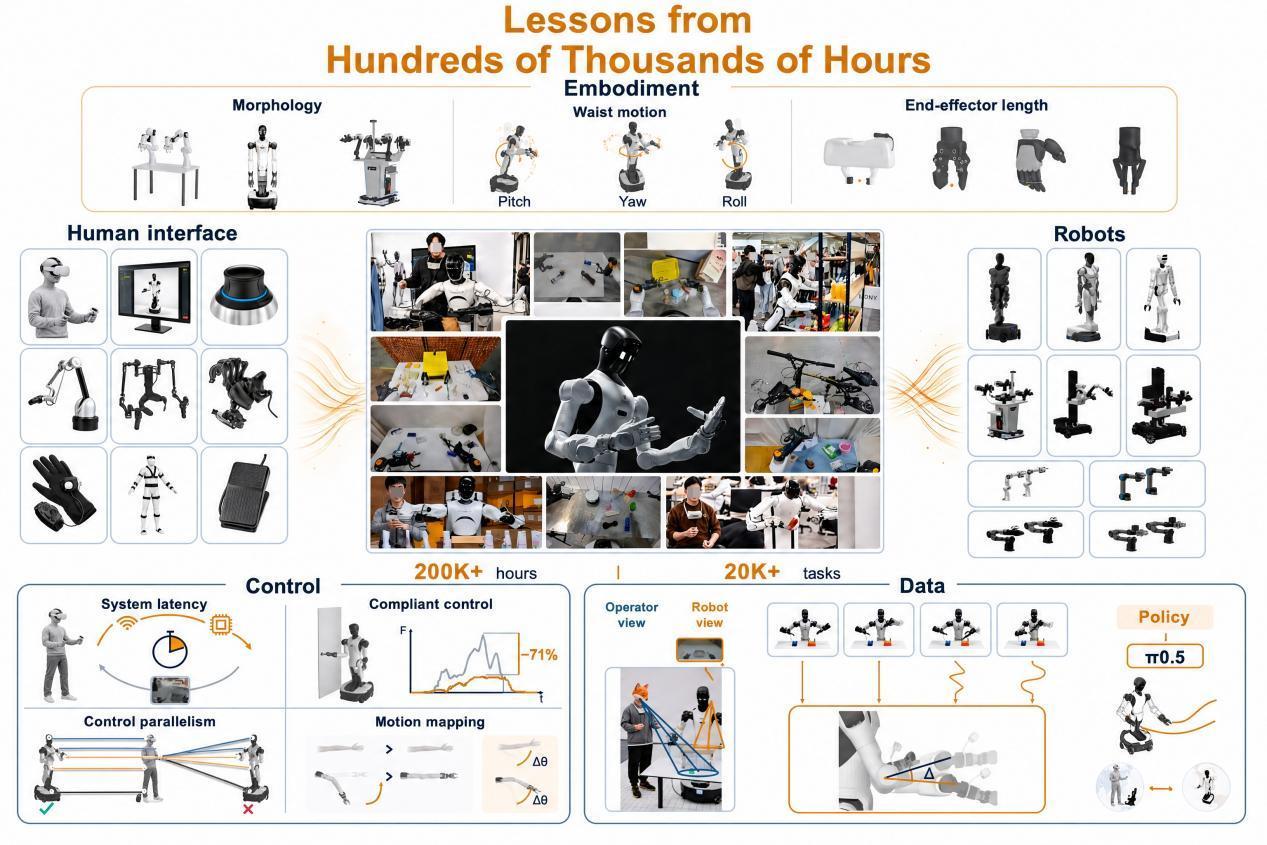
Collecting hundreds of thousands of hours of robotic experience may seem like a major step toward developing more capable machines. However, the quality of that experience matters just as much as its volume. A new Maniformer study, based on more than 200,000 hours of real-robot data, highlights how decisions made during data collection can directly influence the performance of robotic AI systems.
The research, titled Hidden Variables Behind Real-Robot Data Quality: Lessons from Hundreds of Thousands of Hours, examines why apparently successful demonstrations do not always provide useful training signals. Its findings suggest that effective post-training data depends heavily on the design of the robot, its control systems, and the methods used to record interactions.
Paper: https://arxiv.org/abs/2611.22388
Why Successful Robot Demonstrations Can Produce Poor Training Data
A robot successfully completing a task does not necessarily mean that its demonstration is suitable for training an AI model.
Consider two examples of a robot placing an object inside a container. In the first demonstration, the robot identifies the object, selects the appropriate movement, and completes the task efficiently. In the second, the same task is completed after several pauses, unnecessary movements, and corrections caused by delayed controls.
Although both demonstrations reach the desired outcome, they communicate different information to a learning system. The first provides a relatively clear example of task execution, while the second may encourage the model to reproduce inefficient movements.
This distinction becomes particularly important during real-robot post-training. Unlike general pre-training, which can extract useful information from a broad range of visual experiences, post-training directly influences how a particular robotic system behaves. It connects observations with physical actions and helps establish the movement strategies that the robot will later execute.
The Maniformer research investigates this issue through an extensive analysis involving more than 200,000 hours of robotic data, over 20,000 task records, structural assessments of 25 dual-arm robots, teleoperation experiments, and real-world post-training evaluations.
The researchers examined approximately a dozen factors across three major areas: robot embodiment, teleoperation control, and data recording.
Three Hidden Data Problems That Can Affect Robot Learning
The study identifies several situations in which demonstrations that appear successful can introduce misleading information into a training dataset.
1. Incomplete Visual Information
Robotic systems need sufficient visual information to understand their surroundings and make appropriate decisions. When important objects are outside the robot’s initial field of view, the system may lack the information needed to understand why a particular action was selected.
One experiment involved a block positioned outside the robot’s initial view. The human operator selected an arm based on their own visual perspective, but the robot’s recorded observations did not contain enough information to justify that decision.
When models were trained using these demonstrations, they selected the correct arm in approximately 50% of cases, effectively performing at chance level.
The outcome changed when operators were required to share the robot’s visual perspective and search for the object before choosing an arm. Under this approach, the model achieved 100% accuracy in the reported experiment.
This finding demonstrates that recording successful actions alone is insufficient. Training data must also contain the observations that explain the decisions behind those actions.
2. Calibration Errors Between Training and Deployment
Calibration consistency is another important factor in real-robot learning. A model develops an understanding of how particular movements correspond to physical actions on a robot. If that relationship changes, previously learned instructions may no longer produce the intended results.
The research found that datasets collected across different calibration batches could remain useful when a sufficiently consistent portion of the training data matched the calibration of the deployed robot.
However, a more serious problem appeared when the deployed robot itself had a zero-offset calibration error. In this experiment, all 30 real-robot trials failed.
The model continued executing actions based on the relationships it had learned during training, even though the physical robot no longer followed the same mapping.
This illustrates why calibration should not be treated as a minor technical detail. A model can learn an effective movement strategy, but that strategy becomes unreliable when the robot’s physical configuration or coordinate relationships change without being properly accounted for.
3. Inefficient Movements Become Learned Behaviors
Robotic systems can also learn unnecessary movements when inefficient demonstrations are included in their training data.
To investigate this problem, researchers deliberately introduced pauses and detours into otherwise successful demonstrations. The resulting models retained approximately 90% of the additional movement patterns.
The impact was measurable. As the proportion of demonstrations containing detours increased from 0% to 80%, average task completion time rose from 25.3 seconds to 32.6 seconds. This represented an increase of approximately 29%.
The underlying problem is that a model does not automatically understand why an operator made a particular correction or took an unnecessary route. If a demonstration is recorded as a successful example, the system may interpret every part of that sequence as desirable behavior.
For example, an operator might introduce an extra movement to compensate for controller latency or a mechanical limitation. Although this workaround helps complete the task, it does not necessarily represent the best way to perform it.
Without appropriate data filtering and evaluation, these temporary solutions can become permanent parts of the learned action policy.
How Robot Design and Control Systems Influence Data Quality
The research argues that many problems associated with real-robot datasets originate before the recording process even begins. Physical design decisions and control-system limitations can shape the quality of demonstrations long before the data reaches a machine learning pipeline.
Robot Embodiment and Practical Working Space
A robot’s theoretical reach does not necessarily represent its actual ability to complete tasks.
The researchers examined 25 mainstream dual-arm robotic platforms and found that evaluating only positional reach could significantly overestimate their practical task coverage.
For example, increasing a gripper’s length by 10 centimeters expanded reachable positions by approximately 39.4%. However, this modification also pushed certain joints closer to their mechanical limits, potentially reducing the robot’s ability to perform movements comfortably and reliably.
The study also highlighted the importance of waist movement. Allowing the robot to adjust its waist position expanded its effective working space by approximately 3.4 to 5.5 times.
These findings show that robot embodiment should be evaluated in terms of practical task performance rather than simple reach measurements. Mechanical flexibility, joint limitations, and the interaction between different body components all influence the movements available to a robot.
Teleoperation Systems and Control Efficiency
Human-operated robots depend on control systems that translate operator decisions into physical movements. The quality of this interaction can have a substantial effect on the resulting training data.
Traditional control arrangements may require operators to switch repeatedly between different components, including both arms, the waist, the base, and the head. These transitions often force operators to complete movements sequentially, introducing unnecessary pauses.
According to the study, adopting parallel control reduced task completion times by approximately 43% to 53%.
The researchers also evaluated compliant control, which allows robotic systems to respond more appropriately when interacting with physical objects. During door-opening and whiteboard-wiping experiments, compliant control reduced peak contact forces by 71.3% and 69.1%, respectively.
Another important issue involves control latency.
A processing filter may require less than one millisecond to calculate its output, but that does not necessarily mean the overall control system responds immediately. The study found that certain filtering configurations could introduce more than 200 milliseconds of phase lag.
Such delays can cause robots to overshoot their intended positions, make corrective movements, or pause before continuing an action. These behaviors may look like normal demonstrations when recorded, but they can introduce unnecessary movement patterns into the training dataset.
Consequently, improving teleoperation requires more than increasing processing speed. Engineers must also consider synchronization, responsiveness, control architecture, and the physical behavior of the robot.
What Actually Makes Real-Robot Data Effective?
The central message of the Maniformer study is that effective robotic training data must preserve the relationship between what a robot observes, what it decides, and how it physically performs an action.
For robotics companies, the long-term objective should be to establish a continuous development process. Robots collect experience in real environments, machine learning systems use that experience to improve their policies, and the updated models return to physical robots for further testing.
Within this process, every demonstration should be evaluated against three fundamental questions.
Does the robot have enough information to understand the decision?
The recorded observations should include the relevant visual and environmental information needed to explain why a particular action was selected. Missing context can make otherwise successful demonstrations unreliable learning examples.
Will the learned action remain valid on the deployed robot?
The relationship between observations and physical movements must remain consistent. Calibration differences, hardware changes, and control-system variations can undermine a model’s learned behavior.
Does the recorded movement represent the task or a technical workaround?
Training datasets should distinguish between movements required to complete a task and unnecessary actions introduced by system limitations. Otherwise, models may reproduce inefficiencies that were never part of the intended task.
These questions highlight an important shift in how robotic datasets should be evaluated. The number of recorded hours is only one measure of dataset value. The quality, consistency, and usefulness of the recorded experience are equally important.
Two Additional Studies Explore New Approaches to Robotic Learning
Alongside its investigation into real-robot data quality, Maniformer has also been associated with research exploring other approaches to improving robotic intelligence and evaluation.
Two companion studies address the use of human video for robot learning and the evaluation of task progress in real-world environments.
Ego-CEVR: Using Human Video to Improve Robot Learning
The Ego-CEVR (arXiv:2610.37509) study explores how inexpensive first-person human videos can contribute to robotic learning.
Its approach separates two sources of information. Human video provides broader task context, while robot demonstrations teach the system how to perform specific physical actions.
This separation allows robotic models to benefit from human experiences without requiring every training example to come from an expensive robot demonstration.
According to the reported results, Ego-CEVR achieved an average success rate of 98.1% on the LIBERO benchmark. In real-robot experiments, incorporating human video also improved performance across three tasks by approximately 10 to 20 percentage points.
The research suggests that combining human visual experience with robot-specific execution data could provide a more accessible path toward building capable robotic systems.
ReSTEP and REMORA: Improving Robot Task Evaluation
The second companion project, ReSTEP and REMORA, focuses on understanding how robotic systems progress through tasks and recover from mistakes.
The work introduces an open-source dataset containing 3,156 real-robot episodes, with frame-level labels identifying errors throughout task execution.
It also presents a progress estimation approach designed to recognize situations such as object drops, unsuccessful actions, and subsequent recovery attempts.
In the reported evaluations, the proposed progress estimator tracked these events more accurately than the SARM baseline on the tested tasks.
This type of evaluation is important because successful task completion does not always reveal what happened during execution. A robot may encounter several problems before eventually reaching its objective. Understanding these intermediate events can provide valuable information for training, debugging, and improving robotic systems.
Better Data Collection Could Shape the Next Generation of Robotics
The findings from Maniformer’s research highlight a fundamental challenge in developing increasingly capable real-world robots. More training data does not automatically translate into better performance, particularly when the recorded demonstrations contain missing observations, inconsistent calibration, or unnecessary movements.
A successful robotic demonstration should provide more than evidence that a task was completed. It should preserve the information required to understand the decision-making process and reproduce the intended action reliably.
For robotics developers, this means treating data collection as an essential part of system design rather than a separate process that begins after the hardware and controls are finalized.
Improvements in robot embodiment, teleoperation, calibration, and recording methods can all contribute to more useful training datasets. Combined with systematic real-world testing, these improvements can help reduce the gap between what robotic models learn and what they can successfully execute.
Ultimately, the value of 200,000 hours of robotic experience is not determined by the number of hours alone. It depends on whether those experiences teach a model the right behaviors for the right reasons.

