
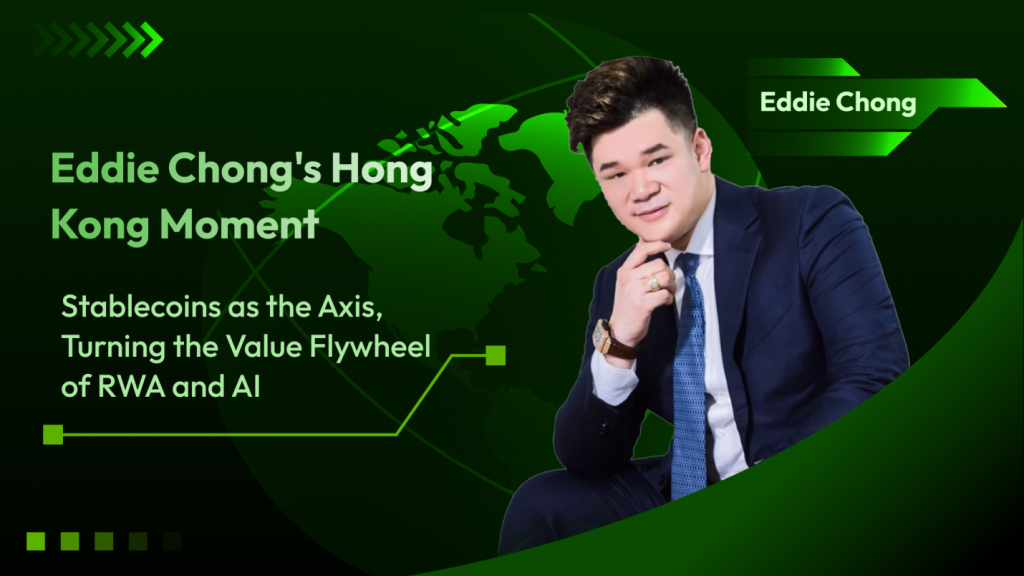
April in Hong Kong was undoubtedly the absolute focal point of the global Web3 compliance track. Dense, layered compliance policies landed one after another — on April 10, the Hong Kong Monetary Authority (HKMA) officially granted the first batch of stablecoin issuer licenses, with Standard Chartered-backed “Anchor” and HSBC standing out from 36 applicants. On April 19, the Hong Kong Securities and Futures Commission (SFC) made another major move, explicitly allowing tokenized authorized investment products to be traded on licensed virtual asset platforms in the secondary market. Throughout April, Hong Kong continuously released compliance signals, and this series of intensive policy implementations not only accelerated the formation of a Web3 compliance ecosystem but also brought the stablecoin and RWA ecosystem that Eddie Chong has been cultivating for years to its optimal inflection point.
For Eddie Chong, Chairman of the SFI (Stable Coin Infrastructure) Ecosystem Foundation, this is the “Hong Kong moment” he has long been waiting for — the successive implementation of core policies such as stablecoin licensing and RWA liquidity access is not only a milestone in global Web3 regulation but also the environment he has been anticipating after years of deep cultivation in the stablecoin and RWA tracks and preparation of the SFI ecosystem. He has been counter-cyclically laying out his strategy for years, working persistently, with only one goal in mind: “to use stablecoins as the axis and turn the value flywheel of RWA and AI.”
I. From 4,000 BTC to $5 Billion RWA: A Long-termist Who Doesn’t Chase Hype, Only Fills Gaps
Eddie Chong, Chairman of the SFI Ecosystem Foundation, founder and president of X Infinity, and executive chairman of HK Web3 Club. Malaysian by nationality, based in Singapore, his business footprint covers Southeast Asia, East Asia, Europe, and the Americas. He is associated with over 100 Web3 and traditional companies, and his entrepreneur-centered community has an influence covering more than 20 million people.
Behind these numbers is a clearer thread of action: not following the crowd, precisely filling industry gaps, with his core focus always on deep cultivation in stablecoin, RWA, and AI-related tracks.
After encountering Bitcoin in 2015, he quickly realized that its processing capacity could not support large-scale payments, so he founded X Infinity to develop a proprietary public blockchain, validating his judgment on crypto payment infrastructure. During the bear market of 2019–2020, he stepped away from short-term speculation and counter-cyclically positioned himself in the RWA track, accurately predicting that blockchain must carry real-world assets to develop sustainably. Today, he oversees a $5 billion RWA portfolio with over 400 cumulative investments.
In 2026, he co-founded SFI, focusing on stablecoin infrastructure and directly addressing the core pain point of RWA adoption: “The core pain point of RWA adoption has never been technology, but users and liquidity — without a compliant user entry point and real liquidity support, even the highest-quality assets are just empty talk once tokenized.” This judgment laid the foundation for the subsequent coordinated development of stablecoins, RWA, and AI.
II. What Is SFI? More Than Stablecoins, a Coordinated Ecosystem Flywheel
SFI’s positioning is clear — an ecosystem platform focused on stablecoin infrastructure. But it is far from a single product; it is a foundational network that enables stablecoins, RWA, and AI to operate in synergy. Its core logic is to integrate payment gateways, consumption scenarios, trading tools, and other key components through investment, incubation, and partnerships, building a closed-loop system covering the entire lifecycle of “assets — payment — consumption — investment — value appreciation.”
Currently, SFI uses Solulu Club as its liquidity core, having already accumulated over 200,000 active users and tens of millions in liquidity depth. Within the ecosystem, five core modules are connected to form a complete value close-loop:
- Solulu Pay: Compliant crypto payment card + fiat on/off-ramp, solving the core pain points of “difficult to enter fiat, troublesome to withdraw fiat,” bridging real users with the crypto ecosystem.
- Caviar: Web3 luxury e-commerce platform, directly supporting stablecoin payments, providing high-net-worth users with a spending outlet for stablecoins while also giving RWA assets a real-world application scenario.
- COPX DAO: Focused on AI quantitative trading and liquidity management, using technology to safeguard asset appreciation.
- RWA Incubator: One-stop institutional-grade digital asset services, supporting compliant RWA asset incubation and tokenization.
- RWA Exchange: Opening compliant secondary market circulation channels, allowing RWA assets to avoid the “once tokenized, locked up” fate, with exit channels and price discovery mechanisms.
Eddie Chong calls SFI, COPX DAO, and Caviar the “Iron Triangle”: SFI builds the infrastructure base, COPX DAO handles value appreciation, and Caviar creates the consumption outlet. The three gears interlock to turn the value flywheel of RWA and AI — and stablecoins are the axis running through it all.
III. Debut Amid Policy Dividends: Hong Kong’s Window Opens, SFI Seizes the Opportunity with Strength
The reason RWA concepts have struggled to scale for years is the lack of compliant user entry points and real liquidity. This April, Hong Kong’s intensive release of Web3 compliance policies precisely filled these two gaps, providing an excellent environment for SFI to accelerate. The stablecoin licensing system clarified the rules for issuing and circulating compliant stablecoins, offering a trusted pricing and settlement tool for RWA assets. The opening of the secondary market for tokenized products, meanwhile, opened liquidity channels for RWA assets, making it a reality that assets can be traded on-chain and holders can exit their positions — positioning Hong Kong as a core hub for the global Web3 compliance track.
Seizing this policy dividend, Eddie Chong led SFI, COPX DAO, and Caviar to make a collective appearance at the Hong Kong Web3 Festival in April. As co-organizers, each played its distinct role, showcasing the full-chain capabilities of the SFI ecosystem across multiple core events, becoming one of the focal points of the industry gathering.
Unlike many institutions that indulge in grand narratives, Eddie Chong addressed the real pain points of the RWA industry directly during a roundtable forum, stating bluntly that “many RWA projects, even after successfully tokenizing assets, stagnate due to a lack of users and eventually become ‘hollow assets’.” He then highlighted SFI’s core advantage: having over 200,000 active users through Solulu Club — precisely the scarcest resource during the cold-start phase of RWA assets.
He also emphasized the importance of consumption scenarios for RWA adoption: “High-net-worth users have real demand for stablecoin spending, and RWA assets precisely need such scenarios to complete the value loop of ‘appreciation → consumption’ and truly bring assets to life.” This pragmatic sharing not only demonstrated SFI’s deep insight into the industry but also solidified the positioning of “stablecoin financial infrastructure.”
The significance of this debut far exceeded brand exposure: SFI’s visibility in core RWA circles was significantly raised, and through the Hong Kong Web3 Festival platform, the company established deep connections with industrial capital, technology providers, and high-net-worth users, laying a solid foundation for future collaboration to advance stablecoin and RWA development by leveraging Hong Kong’s policy dividends. Meanwhile, SFI has already laid out its global compliance strategy ahead of time, having obtained U.S. MSB and Canadian MSB licenses, with UAE VARA and Hong Kong licenses steadily progressing. This compliance matrix not only supports its own operations but also becomes reusable infrastructure for other RWA projects in the industry, fulfilling its philosophy of “being the industry’s base, helping more projects avoid compliance detours.”
IV. Vision Realized: Stablecoins as the Axis, RWA and AI in a Two-Way Embrace
In Eddie Chong’s view, the adoption of RWA is just the first turn of SFI’s value flywheel. Next, the core narrative of the industry will be the deep integration of RWA and AI.
The data speaks for itself: as of early 2026, total on-chain RWA (excluding stablecoins) locked value exceeds $25 billion, and institutions predict that by 2030 this scale will reach tens of trillions of dollars. At the same time, AI agents have evolved from simple auxiliary tools into independent on-chain participants. Future on-chain interactions will move away from the singular human-to-human model toward high-frequency collaboration involving human-to-human, human-to-agent, and agent-to-agent interactions.
“RWA has massive assets waiting to be activated, and AI has massive demand waiting to be matched. The two are a natural two-way embrace.” Eddie Chong’s judgment pinpoints the industry’s future core growth driver. SFI’s ecosystem layout has long been prepared for this deep integration — COPX DAO’s AI quantitative strategies can automatically execute hedging, arbitrage, and other operations, allowing RWA holdings to generate steady returns, solving the pain point of “hard-to-appreciate holdings.” At the same time, AI models output real-time dynamic pricing references based on on-chain data, market sentiment, and asset fundamentals, once and for all addressing the long-standing industry challenge of vague pricing and inaccurate valuation.
Eddie Chong once succinctly summarized his strategic logic: “Compliance is the base, stablecoins are the axis, AI is the engine, and RWA is the fuel.” These four core elements interlock and work together to truly turn Web3’s value flywheel, moving blockchain technology out of the speculative trap and into real-world asset circulation and value creation.
From miner to public blockchain founder, from RWA investor to stablecoin infrastructure builder, every choice Eddie Chong has made has not been about chasing hype, but about identifying the weakest links in the industry and filling them himself. This time, he is using stablecoins as the axis to try to turn the entire value flywheel of RWA and AI. And SFI is doing exactly that — binding these four elements together to drive the industry’s transformation from concept to reality.
Follow SFI and ecosystem partners:
- SoluluPay: https://x.com/SoluluClub_web3
- Caviar: https://x.com/shopcaviar
- COPX DAO: https://x.com/Copx_DAO

