
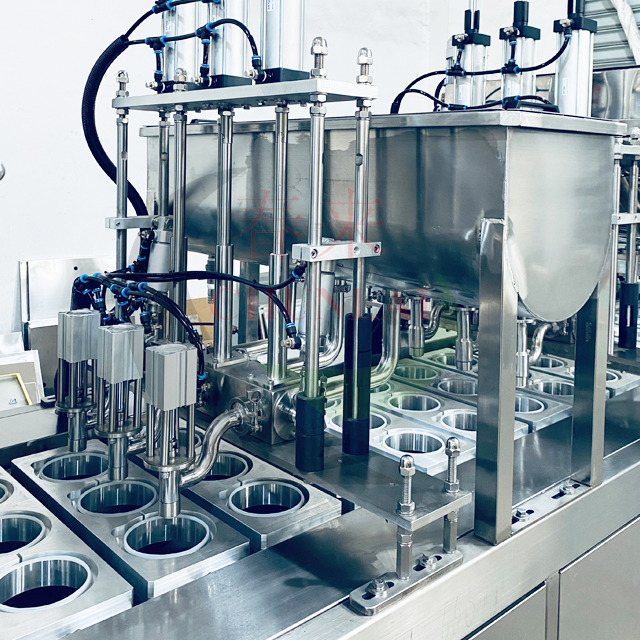
Hummus has moved from the specialty aisle to a mainstream staple, and demand keeps climbing. For producers, that growth creates a familiar bottleneck: filling, sealing, and packaging cups fast enough, consistently enough, and cleanly enough to keep up. Manual and semi-automatic filling can carry a small operation only so far. At scale, automation is what protects margins, quality, and food safety — and modern cup-filling technology has changed what is possible.
The core problem with manual filling is variability. Hand-scooping or hand-operated fillers produce inconsistent fill weights, which means either giving away product through overfill or risking underweight cups that fail quality checks. Multiply a few grams of overfill across hundreds of thousands of cups a year and the giveaway becomes a serious cost. An automatic hummus filling machine uses servo-driven volumetric or piston dosing to hit target weights within tight tolerances, cup after cup, turning that lost margin back into profit.
Speed is the second driver. A rotary filling and sealing system indexes cups through denesting, filling, optional garnish or topping, seal-film application, lidding, and discharge in one continuous motion. Where a manual line might struggle to keep a few workers busy, an automated line can run at dozens of cups per minute with a fraction of the labour — and it holds that pace all shift without fatigue-related drift.
Consistency extends to appearance, too. Consumers judge fresh dips partly on how they look through the lid: a clean fill line, no product smeared on the rim, a properly centred seal. Automated filling with precise nozzles and clean cut-off keeps rims clear so seals are reliable and packages look professional on shelf. A poor seal is not just cosmetic — it is a food-safety and shelf-life failure.
That leads to the most important benefit: hygiene and shelf life. A well-designed hummus cup filling machine is built from food-grade stainless steel with tool-free disassembly for sanitation, minimizing the manual contact points where contamination enters. Paired with modified-atmosphere packaging — flushing the headspace with nitrogen or a gas blend before sealing — automation can extend the refrigerated shelf life of hummus significantly, which means fewer returns, wider distribution, and less waste.
Automation also brings traceability and control. Programmable recipes let a producer switch between cup sizes and fill weights with a few settings rather than a mechanical rebuild. Data on counts, weights, and downtime helps managers spot problems early and prove compliance to retail customers who increasingly demand it.
None of this requires a company to leap straight to a fully automated plant. Many producers scale in stages — starting with a compact rotary system and adding upstream and downstream automation as volume grows. The key is choosing equipment designed specifically for thick, particulate-friendly products like hummus, where a machine built for thin liquids would clog or dose inaccurately.
The takeaway for growing hummus brands is simple: the same technology that increases output also improves consistency, hygiene, and shelf life at the same time. As the category continues to expand, the producers who invest in purpose-built cup filling and sealing are the ones positioned to meet demand profitably — without sacrificing the fresh quality that built their brand.
Anchor text & backlinks used
Anchor: “hummus filling machine” → https://hummuspack.com/
Anchor: “hummus cup filling machine” → https://hummuspack.com/hummus-filling-machine/

