
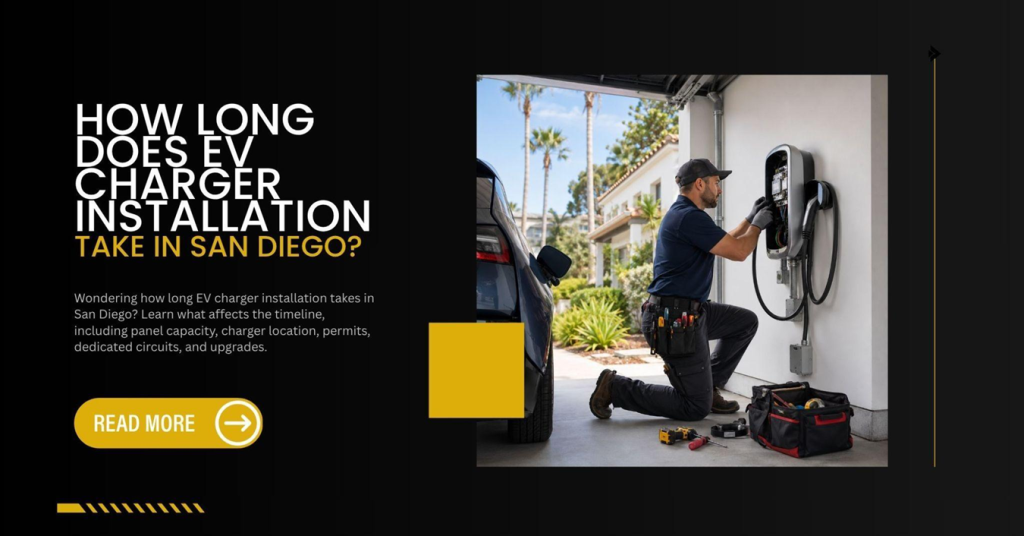
One of the first questions homeowners ask before installing an EV charger is simple: how long will it take?
The answer depends on the property, electrical panel, charger location, wiring route, permit needs, and whether any upgrades are required before the charger can be installed safely. Some EV charger installations are straightforward and can be completed quickly, while others require more planning if the home needs a panel upgrade, service upgrade, trenching, or a longer conduit run.
For homeowners planning EV charger installation San Diego, the best way to understand the timeline is to look at the full process from assessment to final testing.
The Short Answer: Many EV Charger Installations Can Be Completed in One Day
For a standard home EV charger installation, the physical installation may often be completed in one day if the electrical panel has enough capacity, the charger location is close to the panel, and the wiring route is simple.
A more straightforward installation may include:
- Reviewing the panel
- Installing a dedicated circuit
- Running conduit and wiring
- Mounting the charger
- Connecting the breaker
- Testing the charger
- Reviewing the setup with the homeowner
However, the full project timeline may be longer if the job requires permits, utility coordination, a panel upgrade, underground work, or additional electrical improvements.
That is why an electrical assessment is important before giving a final timeline.
What Happens Before Installation Day?
Before the charger is installed, a licensed electrician should evaluate the home’s electrical system. This step helps determine whether the home is ready for the charger or whether additional work is needed first.
During the assessment, the electrician may review:
- Electrical panel size
- Available capacity
- Breaker space
- Current electrical load
- Charger location
- Distance from panel to charger
- Garage, driveway, or carport layout
- Wiring route
- Conduit needs
- Permit requirements
- Future electrical plans
This step can prevent surprises and help the homeowner understand whether the installation is simple or more involved.
A qualified San Diego electrician can also explain whether the current panel can support the charger or if a panel upgrade should be considered.
What Can Make EV Charger Installation Faster?
Some homes are already well set up for EV charger installation. The project is usually faster when the panel has enough available capacity, there is open breaker space, and the charger is being installed close to the panel.
Installation may be faster when:
- The electrical panel is modern and accessible
- There is available breaker space
- The panel has enough capacity
- The charger is near the panel
- The wall is easy to access
- The conduit route is short
- No trenching is needed
- No panel upgrade is required
- The charger equipment is already available
For example, if the panel is in the garage and the charger is being installed nearby on the same wall, the project may be much simpler than installing a charger on the opposite side of the property.
What Can Make the Installation Take Longer?
Some installations require extra planning and labor. This does not mean the project is a problem. It simply means the home’s electrical system or property layout needs more work before the charger is ready.
The timeline may be longer if:
- The panel is full
- The panel does not have enough capacity
- A service upgrade is needed
- A panel upgrade is needed
- The charger is far from the panel
- The wiring route is difficult
- Exterior conduit is required
- Underground electrical work is needed
- The charger is for a detached garage
- The home has older wiring
- Permit approval is required
- Utility coordination is needed
These factors can add time because the project is no longer just about mounting a charger. It becomes a larger electrical planning project.
How Long Does a Level 2 EV Charger Installation Take?
A Level 2 EV charger usually requires a dedicated 240-volt circuit. That means the electrician needs to install the correct wiring, breaker, conduit, and charger connection based on the charger’s requirements and the home’s electrical capacity.
A simple Level 2 installation may be completed the same day. A more complex Level 2 installation may take longer if panel work, longer wiring routes, or permits are involved.
Homeowners should also think about the charger location. A garage installation close to the panel is usually easier than an exterior driveway installation that requires a longer conduit path.
Does a Panel Upgrade Change the Timeline?
Yes. A panel upgrade can change the timeline because it is a larger electrical project.
If your panel is outdated, full, or unable to support the added EV charger load, the electrician may recommend upgrading the panel before installing the charger. This can involve permitting, inspection, utility coordination, and additional scheduling.
A panel upgrade may be needed if:
- The existing panel is too small
- There is no room for a new breaker
- The home already has heavy electrical loads
- Breakers trip frequently
- The system is older
- Future upgrades are planned
- The charger requires more capacity than the panel can safely support
In these cases, the charger installation may not be completed as a simple one-day project. The panel work must be planned first so the charger has a safe electrical foundation.
Does Charger Location Affect Installation Time?
Yes. Charger location is one of the biggest factors in the installation timeline.
A charger installed near the electrical panel is usually faster because less wiring and conduit are needed. A charger installed far from the panel may require more labor, more materials, and more planning.
Common EV charger locations include:
- Garage walls
- Driveways
- Carports
- Detached garages
- Exterior walls
- ADU parking spaces
- Multifamily parking areas
Each location has different requirements. Exterior chargers may need weather-rated equipment and careful conduit placement. Detached garages may require longer wiring routes or underground electrical work. Shared parking areas may require more planning for access and future use.
What About Detached Garages and ADUs?
Detached garages and ADUs can make EV charger installation more involved. These projects often require a closer look at how power will be routed from the main electrical system to the charging location.
For detached garages, the electrician may need to consider:
- Distance from the main panel
- Existing garage power
- Subpanel capacity
- Conduit route
- Underground electrical needs
- Charger placement
- Future vehicle access
For ADUs, the electrician may need to review the added electrical demand of the living space along with the EV charger. An ADU may already require additional circuits, appliances, HVAC support, lighting, and panel planning.
If an EV charger is being added to an ADU or detached parking area, the installation timeline may be longer than a standard garage charger.
Can Permits Affect the EV Charger Installation Timeline?
Permits can affect the timeline depending on the scope of the project and local requirements. Some installations may require permitting and inspection, especially when adding a new circuit, upgrading a panel, or making larger electrical changes.
Permit timing can vary based on the project and local processing. A licensed electrician in San Diego can help homeowners understand whether a permit is needed and what to expect before work begins.
The important thing is to plan the project correctly instead of rushing the installation. A code-compliant installation protects the home, charger, vehicle, and electrical system.
Should You Buy the Charger Before Calling an Electrician?
Many homeowners buy the EV charger first, but it is often better to speak with an electrician before purchasing equipment.
Different chargers have different electrical requirements. Your home’s panel capacity, charger location, and charging goals can affect which charger makes the most sense.
Calling an electrician first can help answer questions such as:
- Can the home support a Level 2 charger?
- What amperage makes sense?
- Is a panel upgrade needed?
- Where should the charger be installed?
- Should the charger be hardwired or plug-in?
- Will the charger work with the available electrical capacity?
This can help avoid buying a charger that is not ideal for the property.
How Homeowners Can Prepare for Installation
Homeowners can help make the process smoother by gathering basic information before the appointment.
Helpful details include:
- The EV make and model
- The charger brand or charger you are considering
- Photos of the electrical panel
- Photos of the desired charger location
- Distance from the panel to the charger location
- Whether the charger will be inside or outside
- Any plans for future upgrades
- Whether the home has an ADU, detached garage, or older panel
This information helps the electrician understand the project faster and provide a more accurate recommendation.
Why Professional Installation Matters
EV charger installation should be handled by a licensed electrician because the charger connects directly to your home’s electrical system. The installation needs the right wiring, breaker sizing, load evaluation, and connection method.
Professional installation helps prevent:
- Overloaded circuits
- Incorrect breaker sizing
- Undersized wiring
- Unsafe connections
- Poor charger placement
- Repeated breaker trips
- Failed inspections
- Future electrical limitations
If your home already has electrical issues such as flickering lights, tripping breakers, dead outlets, or an outdated panel, those should be reviewed before adding a major new load. Professional electrical service and repair San Diego support can help identify problems before the charger is installed.
Frequently Asked Questions
How long does EV charger installation usually take?
A straightforward EV charger installation may often be completed in one day if the panel has enough capacity and the charger location is close to the panel. More complex projects can take longer if a panel upgrade, permit, long conduit run, detached garage setup, or underground electrical work is needed.
Can a Level 2 EV charger be installed in one day?
Yes, many Level 2 EV charger installations can be completed in one day when the electrical system is ready and the wiring route is simple. If additional upgrades are needed, the timeline may be longer.
What makes EV charger installation take longer?
Installation can take longer when the panel is outdated, full, or underpowered, when the charger is far from the panel, when underground conduit is needed, or when permits and inspections are required.
Do I need a panel upgrade before installing an EV charger?
Not always. Some homes can support an EV charger with the existing panel. Others may need a panel upgrade or service upgrade depending on available capacity, breaker space, and current electrical demand.
Should I call an electrician before buying an EV charger?
Yes. Speaking with an electrician first can help you choose a charger that fits your home’s electrical system, charging goals, and installation location.
Can an EV charger be installed outside?
Yes. EV chargers can be installed outside when the correct equipment, weather-rated setup, conduit, and electrical protections are used. The installation location should be reviewed by a licensed electrician.
Can EV chargers be installed in detached garages?
Yes. EV chargers can be installed in detached garages, but the project may require additional planning for power routing, conduit, subpanel capacity, or underground electrical work.
Final Thoughts
EV charger installation timelines can vary from a simple same-day installation to a more involved project that requires panel work, permits, underground electrical, or additional planning.
The best first step is to have the property evaluated before installation begins. This helps determine whether the home is ready, where the charger should go, and whether any electrical upgrades are needed first.
For homeowners considering EV charger installation San Diego, planning ahead can make the process smoother, safer, and better prepared for long-term charging needs.

