
Key Takeaways
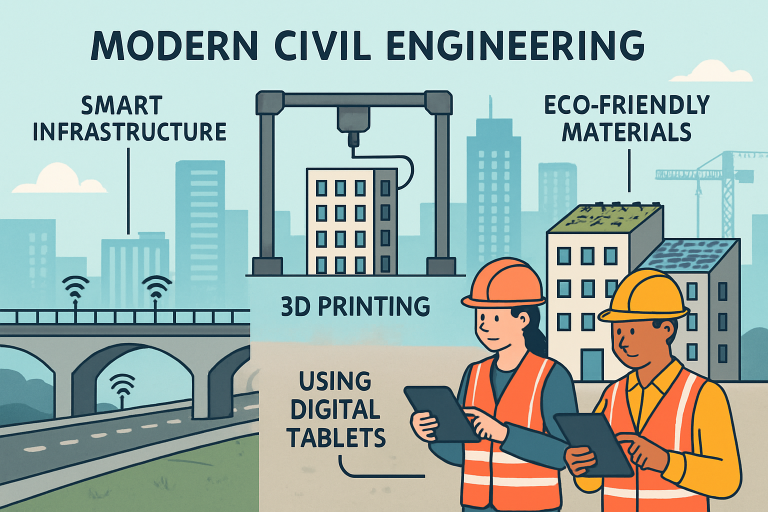
- Advanced technologies like AI and IoT are significantly improving project timelines, safety, and resource management.
- Sustainable construction materials are crucial in reducing the environmental impact and ensuring the longevity of structures.
- Digital tools such as BIM and digital twins foster improved collaboration and data-driven decision-making.
Introduction
Civil engineering is undergoing a new era with the rapid adoption of advanced technologies and a focus on sustainability. This shift is transforming the design, construction, and management of infrastructure, creating more resilient, cost-effective, and sustainable environments for future generations. Land surveying services are crucial for accurate mapping, project management, and maintenance. As cities expand and infrastructure becomes more complex, the adoption of digital tools and materials is increasing, accelerating construction timelines, reducing operational costs, and mitigating environmental impacts. By integrating smart technologies and sustainable practices, civil engineering is advancing towards an efficient and environmentally responsible future for infrastructure development.
Smart Infrastructure and Digital Twins
The fusion of Artificial Intelligence (AI), Internet of Things (IoT), and digital twins is catalyzing a transformation in infrastructure management. Digital twins are sophisticated, virtual representations of physical assets—be they bridges, urban transit systems, or entire buildings—which allow for real-time oversight, model testing, and predictive maintenance. Integrating IoT sensors across critical infrastructure enables engineers to gather real-time data about structural health and environmental stresses, allowing for quick, data-driven decisions and early interventions before failures occur. Predictive maintenance powered by AI significantly reduces costs, minimizes downtime, and extends the lifespan of high-value assets by anticipating and preventing breakdowns. Industry leaders are investing in these technologies to create infrastructure that is not only smarter but also safer and more adaptable to the complexities of modern urban growth.
3D Printing in Construction
3D printing, particularly 3D concrete printing (3DCP), is revolutionizing construction by offering transformative solutions for residential, commercial, and municipal projects. Large-scale 3D printers can create building components or entire structures directly from digital models, with a high degree of precision and at unprecedented speeds. This reduces labor costs, limits material waste, and creates opportunities for sustainable construction using recycled materials or bio-based composites. Notably, the customization inherent in 3D printing supports innovative architectural designs that optimize structural performance while consuming less raw material. In disaster-prone or housing-shortage regions, 3D printing has shown remarkable potential to deliver safe, durable, and affordable solutions at scale.
Sustainable Construction Materials
In response to mounting climate concerns, civil engineers are adopting next-generation, sustainable materials that dramatically reduce environmental impact. Self-healing concrete, which utilizes embedded bacteria or chemical agents to automatically repair cracks, extends infrastructure longevity and reduces the need for costly repairs. The use of recycled materials—such as plastic bricks, reclaimed steel, and hempcrete composites—not only diverts waste from landfills but also decreases greenhouse gas emissions associated with traditional construction. Innovations like photovoltaic (PV) glass generate solar power, while kinetic paving systems harness footsteps or vehicle movement to create renewable energy. Combined, these materials are shaping the greener, more resource-efficient cities of the future.
Building Information Modeling (BIM) Advancements
Building Information Modeling (BIM) technology anchors modern construction projects, providing a collaborative digital ecosystem for planners, engineers, and contractors alike. The advent of cloud-based BIM platforms allows real-time, multi-disciplinary collaboration regardless of location, fostering greater accuracy in project delivery. AI-powered enhancements now automate repetitive design tasks, optimize resource allocation, and help to identify potential clashes or scheduling issues before construction begins. By integrating digital twins with BIM, civil engineers gain deeper insight into performance analytics and lifecycle management, encouraging better decisions from project conception through long-term maintenance. As a result, BIM-driven workflows are becoming indispensable for large-scale infrastructure projects worldwide.
Automation and Robotics in Construction
Automation and robotics are playing an increasingly dominant role on construction sites. Advanced robotic systems, such as bricklaying machines and automated welders, are enabling rapid, precise assembly of building components with fewer errors and lower safety risks. Drones are now routinely used for site surveying and progress tracking, delivering highly accurate topographic maps and real-time visual updates. Additionally, exoskeletons support workers physically, helping prevent injuries from repetitive or strenuous tasks. Such tools are improving construction timelines, cutting labor costs, and rendering sites safer and more resilient in the face of labor shortages or adverse conditions.
Modular and Prefabricated Construction
Modular and prefabricated construction techniques are revolutionizing infrastructure delivery by prioritizing speed and quality. These methods allow for quick assembly on-site, reducing weather delays and material waste, making them valuable for critical infrastructure, housing, and disaster relief. Sustainable prefab materials like recycled steel frames and renewable insulation products further reduce environmental impact. Modular methods help meet urban infrastructure demands efficiently. Civil engineers are embracing smart technologies, sustainable practices, and digital tools to create a future where infrastructure is adaptive, resilient, and environmentally conscious, addressing urbanization demands and climate change challenges.

