
Ophilus unveils Khora, a next-generation multiplayer world model developed with RhOS, showcasing an eight-player real-time demo that demonstrates scalable AI-generated worlds in action ophilus.ai/khora.
Ophilus has officially introduced Khora, an advanced multiplayer world model designed to overcome one of the biggest challenges in AI-generated environments: scaling from a handful of participants to potentially thousands while maintaining a consistent shared world.
To demonstrate its capabilities, the company has released a public eight-player deathmatch experience that anyone can play. The live demo transforms Khora’s research into an interactive environment where players can directly experience its real-time multiplayer technology.
Experience Khora Through a Live Multiplayer Demo
Rather than presenting the technology through research papers or recorded videos, Ophilus allows users to test Khora firsthand.
Players enter an AI-generated battlefield where they compete against others in fast-paced first-person combat. Every match features dynamic environments, detailed maps, player movement, weapon combat, scoreboards, kill tracking, and end-of-game statistics.
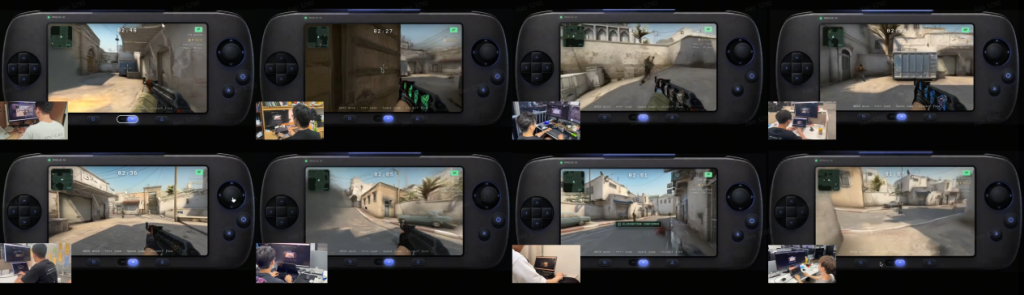
Eight players compete in real time in Khora’s public demo at ophilus.ai/khora
Unlike traditional multiplayer games built with handcrafted environments, Khora continuously generates and maintains the world while multiple people interact inside it simultaneously.
The public demonstration serves as practical evidence that the system can support synchronized multiplayer gameplay while maintaining responsive performance and visual consistency.
Why Multiplayer World Models Are So Difficult
Building a world model for one player is already challenging.
The AI must predict what appears next based on every movement. Looking left requires generating what should exist on the left side of the world. Turning around requires predicting what should appear behind the player.
This process becomes significantly more complex when multiple players share the same environment.
Every participant expects the world to behave identically.
If one player opens a door, every other player must immediately see the same door open.
If two players meet in a hallway, both perspectives must agree on each other’s exact location and movement.
Objects cannot exist in different states for different players.
Maintaining that level of synchronization while generating environments in real time has remained one of the largest obstacles in multiplayer world modeling.
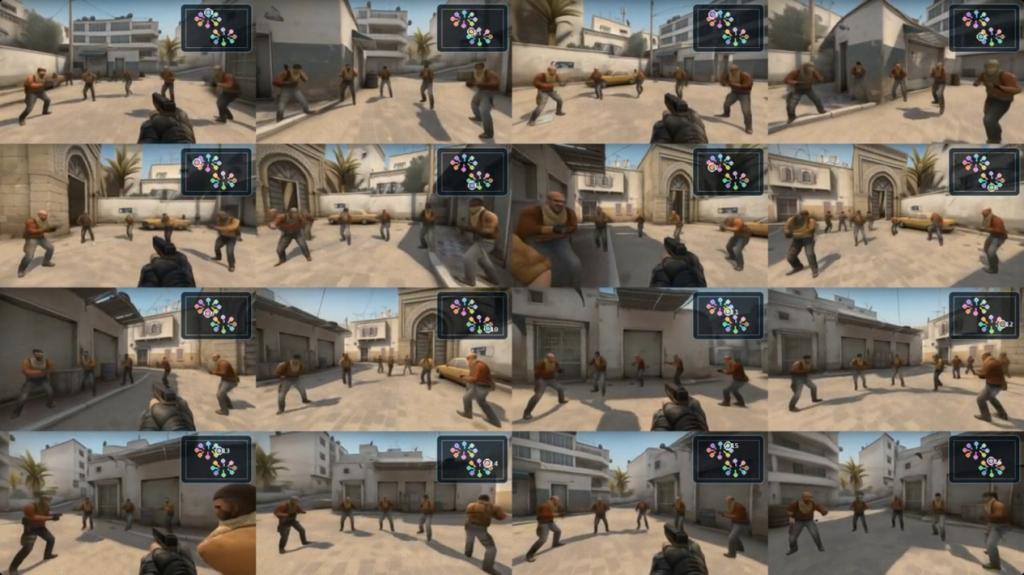
Sixteen generated player views, synchronized through the same evolving world state.
Khora approaches the problem differently.
Instead of generating isolated worlds for each participant, every player interacts with a single evolving world state.
Each action performed by a player updates this shared environment.
The AI then generates every participant’s next view using the latest version of that common state.
This approach keeps all players synchronized while allowing every individual viewpoint to be rendered independently.
As a result, combat, movement, exploration, and interactions remain consistent from every perspective.
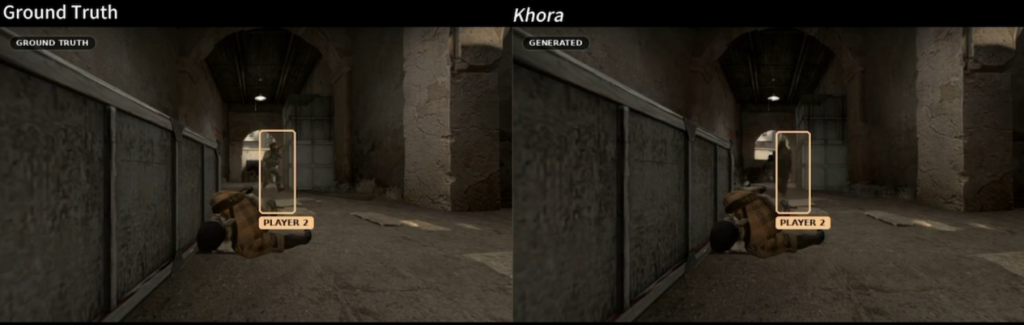
cross agent action consistency in Khora
The Evolution of Multiplayer World Models
Several research projects have helped establish the foundation for multiplayer AI worlds.
Solaris, created by a research team that included Saining Xie, demonstrated that two users could exist inside a jointly generated environment. Its companion framework, SolarisEngine, also introduced an open system for collecting synchronized multiplayer gameplay data in Minecraft.
Although these projects represented important milestones, they primarily supported limited numbers of participants and faced challenges involving real-time inference and long-term consistency.
Other research expanded different aspects of the problem.
Agora-1 demonstrated impressive real-time generation, although its public demonstrations focused on relatively simple environments with minimal visual complexity.
MIRA pushed visual quality further while still supporting only a limited number of simultaneous participants.
Collectively, these efforts proved that multiplayer world generation was possible, but scaling remained an unresolved challenge.
Khora focuses specifically on solving that limitation.
A Smarter Scaling Architecture
Traditional multiplayer communication becomes increasingly expensive as additional players join.
If every participant must exchange information with every other participant, communication grows exponentially.
For example, a system supporting 1,024 participants would require well over one million individual communication relationships.
Khora replaces that approach with a centralized architecture called STBoard, short for Spatio-Temporal Board.
Instead of communicating directly with every other player, each participant reads from and writes to this shared world state.
Whenever someone performs an action, a state transition model updates STBoard.
Each player’s next frame is then generated independently using their own local perspective combined with the updated shared information.
Because every participant references the same evolving world rather than communicating with every other participant individually, computational complexity grows linearly instead of quadratically.
According to Ophilus and RhOS, this makes Khora the first scalable multi-agent world model designed with linear-time complexity.
In practice, adding another participant simply requires generating another viewpoint rather than creating an entirely new network of player-to-player interactions.
Looking Ahead
Ophilus and RhOS have already announced the next major milestone for Khora.
A significant update planned for mid-August will expand testing beyond the current demonstration.
The upcoming release aims to showcase stronger generalization across a wider variety of procedurally generated maps, artistic styles, and gameplay scenarios.
These improvements are intended to demonstrate that Khora can adapt to diverse environments instead of performing well only within a single test world.
The Vision Behind Ophilus
Ophilus is a new initiative built on Yahaha, a platform focused on creating and sharing multiplayer 3D experiences.
The company uses synchronized multiplayer interactions as valuable training data for AI world models, enabling them to learn how shared virtual environments evolve through player behavior.
Its long-term objective extends beyond simply building playable demonstrations.
Ophilus aims to create multiplayer world models capable of supporting increasingly larger numbers of users while maintaining high visual quality, real-time responsiveness, and reliable consistency across every participant.
Khora represents the first major step toward that broader vision.
Applications Beyond Gaming
Although gaming provides an ideal environment for testing multiplayer world models, the underlying technology has applications far beyond entertainment.
Scalable shared-world AI systems could support collaborative virtual workspaces, embodied AI research, multi-agent training environments, interactive storytelling, virtual production, digital simulations, and next-generation immersive experiences where many users interact inside dynamically generated worlds.
As these models continue to improve, they may become foundational technology for a wide range of future AI-powered virtual environments.
Try the Public Demo
Players interested in experiencing Khora firsthand can access the live eight-player demonstration through Ophilus.
The company also encourages users to follow @OphilusAI and @RhOS_AI on X for gameplay videos, development updates, and announcements regarding the upcoming expansion of the platform.
If you’d like, I can also rewrite it in a TechCrunch, VentureBeat, or Cointelegraph editorial style with a more journalistic tone.

