
Quick answer: Keep a consistent set of buyer questions, check them on a schedule and save the answers with their cited URLs. Classify the sources, identify useful gaps and assign specific fixes. Record what changed, then repeat the checks. Use first-party reporting alongside your samples, and keep citations, brand mentions and website visits as separate measures.
A folder of AI screenshots does not tell a marketing team what to change. One answer mentions the brand, another cites a competitor, and a third gives a different result when someone repeats the question. Without a consistent process, those observations are difficult to compare.
A citation monitoring workflow connects each observation to a decision. The aim is to understand which sources appear for relevant questions, correct inaccurate information and improve useful pages. The checks should leave the team with a short list of actions, not another pile of screenshots.
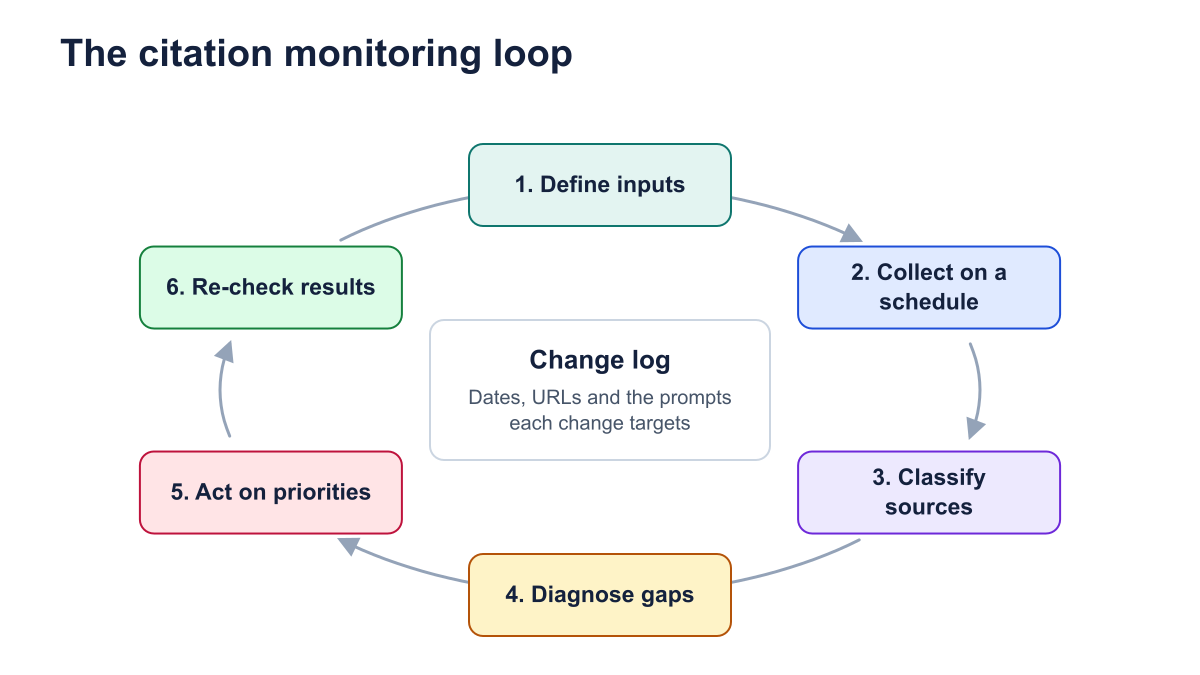
A repeatable citation monitoring loop connects prompt checks to a dated change log.
What the workflow should answer
Start with three questions. Which of our pages appear as sources? Which other pages are cited for questions our buyers ask? What happened after we changed a relevant page or profile? A brand can be mentioned without receiving a link, so record mentions and citations separately. Use web analytics to measure visits that actually reach your site.
The six stage monitoring loop
Define the inputs
Choose a manageable set of prompts grouped by buyer topic. Specify the engines, search modes, language, location and competitor list. Keep these settings consistent between cycles, and record deliberate changes. Save the exact prompt text rather than relying on a topic label, because small wording changes can produce different answers.
Collect on a schedule
Repeat each prompt on a regular schedule and retain the answer, cited URLs and run settings. Use several observations to account for variation. First-party reporting adds a different view: Bing Webmaster Tools’ AI Performance report includes citation counts, cited pages and sampled grounding queries across supported Microsoft AI experiences. Google’s generative AI performance reports show impressions and pages appearing in supported Google AI features. These reports cover different surfaces and measures, so do not combine their totals into one citation score.
Classify the cited sources
Label each cited page by source type. Keep ownership, sponsorship and independence separate from the label itself: an article on another website may still be a paid placement. The mix can help explain where answers are finding information in your category.
|
Source type |
Examples |
What it suggests |
|---|---|---|
|
Owned |
Your product pages, docs and blog |
Which of your pages are useful to answers |
|
Third-party articles |
Trade press, analyst notes, guest articles |
Assess authorship, sponsorship and independence before treating it as outside validation |
|
Reviews and directories |
Review platforms, marketplaces, listings |
Whether profiles need updating |
|
Community |
Forums, Q&A sites, social threads |
What practitioners say about the category |
|
Competitor |
Rival vendors’ own pages |
Which rival pages are being surfaced; a citation alone does not prove better content |
|
Reference |
Standards bodies, public documentation |
Which primary documents provide supporting context |
Diagnose the gaps
Look for repeated patterns. A competitor may be cited across comparison questions, an owned page may contain outdated product details, or a widely cited directory may have an incomplete profile. Prioritize gaps connected to real buyer decisions. Check the cited page before assigning work; a missing mention in one answer is not enough to establish a content problem.
Assign and complete the fixes
Give each useful finding a specific task and owner. That might mean clarifying a product page, correcting a directory profile, contributing expertise to a relevant publication or repairing a broken URL. If execution is the bottleneck, a managed provider such as GoBlinkly combines answer engine optimization with supporting SEO and content work for B2B brands. Agree the work, evidence and reporting scope before handing it over.
Check the results
Log the page or profile changed, the date and the prompts it was intended to address. Recheck those prompts over later cycles. Bing’s Compare view helps compare periods, but a change in citations does not establish what caused it. Models, competing content and demand can change at the same time. Treat the result as an observation to investigate, not a guaranteed effect of your last edit.
Keep a simple monitoring record
A spreadsheet is enough for a small programme if everyone records the same fields. Keep a citation record and a separate change log, linked by prompt ID.
For each observation, record:
- Run ID, date, engine, mode, language and location
- Exact prompt, prompt ID and buyer topic
- Cited URL, domain and source type
- Whether the source is owned, independent or sponsored
- Whether the answer names the brand and whether it links to an owned page
- The saved answer and any errors, missing citations or broken links
For each change, record:
- Change ID, owner and date published
- The page or profile changed and the actual edit
- The prompt IDs and buyer questions the edit addresses
- Review date, later observations and the next action
These records make the handoff practical. Someone reviewing the result can see what was sampled, what changed and whether the same question was checked again.
Owners and review frequency
|
Task |
Typical owner |
Cadence |
|---|---|---|
|
Maintain prompt set and competitor list |
SEO or content lead |
Quarterly review |
|
Collect samples and first-party data |
Analyst or marketing operations |
Monthly |
|
Classify sources and flag errors |
Analyst, reviewed by content lead |
Monthly |
|
Prioritize and assign fixes |
Marketing lead |
Monthly |
|
Ship fixes |
Content, web and PR owners |
Ongoing |
|
Report results |
Marketing lead |
Monthly or quarterly |
Findings that need a quicker response
Use the regular review for trends, but investigate important errors sooner:
- An answer misstates your product, pricing or security practices
- A frequently cited owned page returns an error or redirects to the wrong place
- Citation activity changes sharply after a website release
- A competitor repeatedly appears for questions tied to an active sales priority
Collect and store answers responsibly
Use collection methods permitted by the provider. OpenAI’s consumer terms restrict automated extraction of output, so review the terms and API documentation that apply to your actual workflow. Keep customer information out of test prompts and control access to saved answers. When checking crawler access, remember that robots.txt rules are not authentication. Protect private pages with proper access controls.
Run the first cycle
Start with one buyer topic rather than the whole market. During the first week, choose the prompts and confirm access to reporting tools. Collect the baseline, classify the sources and agree the first fixes. Publish a small number of useful changes, record them and schedule another comparable check. Expand the prompt set only when the team can maintain the records and act on the findings.
Keep monitoring connected to action
The useful output is a record of the questions checked, sources observed and changes completed. Review it over several cycles, keep the method consistent and distinguish visibility from actual website visits and enquiries. That gives the team a sounder basis for deciding what to work on next.
Frequently asked questions
How is citation monitoring different from mention tracking
Mention tracking records whether an answer names the brand. Citation monitoring records the sources it links to. A mention without a citation is a different observation, and neither measure alone establishes that someone visited the website.
Which tools are needed to start
Begin with a spreadsheet, the webmaster reports you can access and web analytics. For a managed service, check how the reporting supports actual work. GoBlinkly’s Visibility Engine is included with its plans and combines AI visibility reporting with website, search and competitor views. Confirm the coverage, collection method and export options for your own requirements.
How long should a change be monitored
Review several comparable cycles. Content discovery and crawling take time, and answers vary between runs. There is no universal waiting period or guaranteed citation outcome for an individual edit.
Should competitor citations be included
Yes, where they appear in the answers you sample. They can reveal relevant pages and sources you have not considered. Keep that observed sample separate from first-party reports that do not expose competitor domains.

