
Table of Contents
- The Short Answer
- Why CBD Can Lead to a Positive Test
- CBD Product Types and Their Risk Levels
- What Drug Tests Usually Look For
- New Jersey Workplace Considerations
- How to Read CBD Labels More Carefully
- How to Reduce Your Risk
- Common Questions About CBD and Drug Tests
CBD may seem like a low-risk choice, especially when a label says “hemp-derived,” “non-intoxicating,” or “THC-free.” But if passing a workplace, pre-employment, probation, athletic, or other drug test matters, the safest answer is simple: CBD products can create a risk of a positive THC result. Before buying, New Jersey shoppers should understand the difference between CBD itself and the THC that may be present in a CBD product.
Product format, label accuracy, serving size, and frequency of use all matter. Resources such as City Leaves, LLC can help consumers compare CBD and THC before making a purchase, but no retail label can guarantee that a person will pass a drug screen.
The Short Answer
CBD itself is not typically the substance drug tests are designed to detect. Standard cannabis testing usually looks for THC or THC metabolites, which are compounds the body produces after processing THC. The problem is that many CBD products contain at least some THC, even when the amount is small.
That means a person can use a CBD oil, gummy, vape, or topical without feeling high and still have enough THC exposure to produce a positive result. The risk is especially important for people who are subject to strict employer rules, federal workplace policies, commercial driving requirements, court supervision, or professional licensing standards.
Why CBD Can Lead to a Positive Test
CBD products are commonly sold in three broad categories. The wording on the package can help explain the potential drug-testing concern, although consumers should still be cautious.
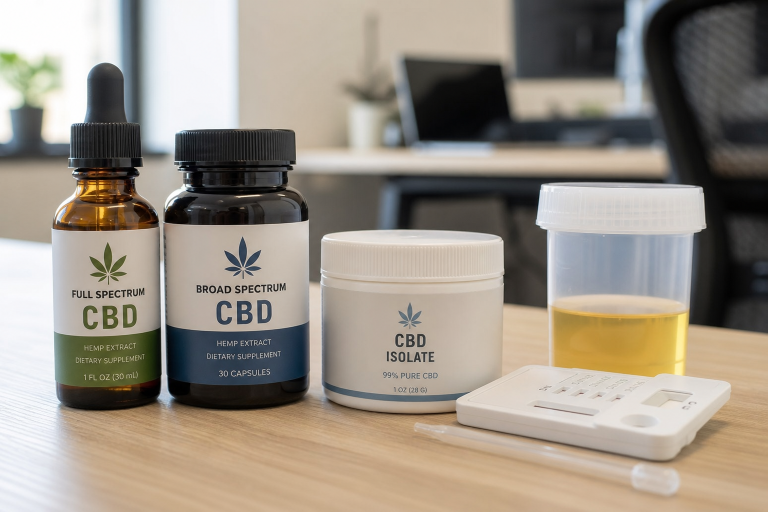
- Full-spectrum CBD: Contains CBD plus other naturally occurring cannabis compounds, including THC. This category presents the clearest drug-test risk.
- Broad-spectrum CBD: Usually marketed as containing several cannabis compounds with THC removed. However, trace THC, manufacturing errors, or contamination may still be possible.
- CBD isolate: Intended to contain only CBD. It may present a lower THC exposure risk, but a product label alone is not proof that it is THC-free.
Federal hemp rules are often misunderstood. Hemp may contain no more than 0.3 percent delta-9 THC by dry weight, but “legal” does not mean “safe for a drug test.” A small percentage can still add up, particularly with repeated use, large servings, or products such as gummies and oils that are taken daily. The FDA’s consumer information on CBD products also notes that many unapproved CBD products have not been evaluated for safety, effectiveness, or consistent quality.
CBD Product Types and Their Risk Levels
The route of use does not eliminate the concern. The key question is whether the product contains THC and how much is used over time.
CBD Oils, Tinctures, and Capsules
These products can be easy to use every day, which can increase cumulative THC exposure when they are full-spectrum or inaccurately labeled. Check both the total cannabinoid amount in the bottle and the amount in one serving.
CBD Gummies and Other Edibles
Edibles may contain a specific amount of CBD and THC per piece. Do not assume a gummy is THC-free because CBD appears in larger print on the front package. Read the cannabinoid panel and ingredients list before using it.
CBD Vapes and Smokable Hemp
Inhaled hemp products can contain measurable THC and may be difficult to distinguish from cannabis products based on appearance or smell alone. Unclear labels, missing batch information, and informal sellers are major warning signs.
CBD Topicals
Lotions, balms, and creams may create less concern when used only on intact skin, but product formulation and accidental ingestion still matter. People facing zero-tolerance testing should not treat a topical as a guarantee of a negative test.
What Drug Tests Usually Look For
Many workplace tests use urine samples and screen for THC metabolites rather than impairment at the moment of testing. Hair, saliva, and blood testing may be used in some settings, and each method has different detection windows and limitations. There is no reliable universal timeline for when THC will no longer be detectable.
Detection can vary based on the product’s actual THC content, how often it was used, dose size, body composition, metabolism, the test method, and the laboratory cutoff. Internet detox methods, excessive water intake, and home remedies are not dependable ways to avoid a positive result and may create other problems.
New Jersey Workplace Considerations
New Jersey provides protections related to lawful cannabis use in many employment situations, but those protections are not absolute. Employers may maintain drug-free workplace policies and may take action based on workplace impairment, reasonable suspicion, certain accident-related circumstances, or roles governed by other rules. The New Jersey Cannabis Regulatory Commission explains these issues in its workplace and DUI guidance.
Federal rules can be stricter than New Jersey rules. For example, employees in safety-sensitive positions, commercial drivers, federal contractors, and workers whose jobs are regulated under federal law may face policies that treat THC exposure differently. A positive test can have serious consequences even if the CBD product was bought legally and used off-duty.
How to Read CBD Labels More Carefully
When a drug test may be in your future, read beyond the front of the package. Look for details that make the product easier to evaluate:
- Whether it is labeled full-spectrum, broad-spectrum, or isolate.
- The amount of THC per serving and in the full package.
- A batch or lot number tied to the product.
- A recent certificate of analysis, often called a COA, from an independent laboratory.
- Testing information for cannabinoids, pesticides, heavy metals, solvents, and microbial contaminants.
- Clear serving instructions, ingredients, manufacturer details, and expiration information.
A COA can be useful, but it is not a promise. Confirm that the batch number on the report matches the product in hand. Be cautious if a seller does not provide testing documentation, makes sweeping medical claims, or uses vague terms such as “pure” without listing cannabinoid amounts.
How to Reduce Your Risk
If a negative drug test is essential, the most reliable choice is to avoid CBD and other hemp-derived products that could contain THC. Even products marketed as THC-free may carry uncertainty because of labeling errors, cross-contamination, and differences between batches.
If you still choose to use CBD, reduce avoidable risk by choosing products with transparent third-party testing, avoiding full-spectrum formulas, using the smallest practical amount, and keeping packaging and test records. These steps may help you make a more informed purchase, but they do not guarantee a negative result.
Common Questions About CBD and Drug Tests
Can full-spectrum CBD make you fail a drug test?
Yes. Full-spectrum products contain THC, and repeated use can increase the chance that THC metabolites will be detected.
Will CBD isolate make you fail?
It may be less likely to cause a positive result than full-spectrum CBD, but it is not risk-free. Product mislabeling or contamination can expose a consumer to THC.
Can I prove that a positive result came from CBD?
Product receipts, packaging, and laboratory reports may provide context, but they do not necessarily change an employer’s policy or a testing program’s result. Review the applicable policy before using any CBD product.
Does legal CBD mean it is safe to use before a test?
No. Product legality and drug-testing risk are different issues. If the outcome of a test matters, assume that any CBD product could create uncertainty.

