
Key Takeaways
- Newcastle Central station, which Queen Vic herself opened back in August 1850 and is now a Grade I-listed gem, is both the key transport hub for the city and a work of genius in railway engineering that takes up a good 3 acres.
- Architect John Dobson teamed up with engineer Robert Stephenson to give the station a really fancy Romano-Italian frontage and a super clever curving wrought-iron train shed that basically helped shape the whole city as we know it today.
- But its not just the outward appearance that gives Newcastle Central its importance. The place has some amazing hidden infrastructure – undercroft spaces, complicated foundation work and seriously sophisticated signalling systems that are still critical to how the place runs today.
- The 1850 roof was recently restored using traditional leadwork techniques, which was a big job that required a lot of skill to get right and get that original engineering style back to its former glory, all while meeting 21st century standards.
- If you want to truly understand what makes Newcastle Central Station so special you need to look beyond just its fancy looking front to how its actual engineering has shaped the streets, hotels and commercial districts that make up Tyneside.
Overview of Newcastle Central Station
Newcastle Central is the mainline station for Newcastle upon Tyne – it’s been open since 1850 and its a Grade I-listed building that the railway industry likes to describe as a real triumph of British engineering. The sweeping barrelled roof and palatial portico set the style for the East Coast Main Line – and it’s hard to argue with that.
The station is a pretty major spot on the line between London King’s Cross and Edinburgh, with lots of direct services operated by all the big players – London North Eastern Railway, CrossCountry, TransPennine Express, Northern and Lumo. And beneath the main concourse you’ll find Central Metro station, which connects passengers to the Tyne Wear network – so you can get the train from the Airport to the coast to wherever you need to be next.
But its more than just a normal train station – Newcastle Central is basically an engineering cathedral. The curving roof spreads over the platforms like a nave and the stone porte-cochere acts as a kind of dignified transitional space between the city and the railway. This article is going to take a closer look at the hidden structure beneath the platforms, the old signalling systems that were in use back in the day, and just how the station’s design really helped shape the way Newcastle grew in the Victorian era.
Origins, Vision and Early Construction (1830s–1850)
Back before 1850 Newcastle had three completely separate train stations – the Newcastle & Carlisle Railway used Redheugh terminus, the Newcastle & North Shields line operated from Carliol Square, and George Hudson’s Newcastle & Berwick Railway was getting bigger without any decent facilities. This was all a bit of a mess, with trains going off in all different directions and really causing a lot of chaos.
George Hudson, known to some as the ‘Railway King’, was determined to change this and create a ‘general station’ that would bring all the different lines together in one place, all connected to the English network, and then up to Edinburgh. He chose a spot just north of the Tyne near Spital, because it made sense to keep trains off the river and then get them up the hill with some rope-worked incline.
In February 1846, architect John Dobson was brought in alongside engineer T.E. Harrison and Robert Stephenson, to come up with a design that would work for the new station. Dobson was already making his mark on Newcastle with Grey Street and Grainger Town, and now he had the chance to bring his skills to bear on this big new project, but with the added difficulty of it having to connect loads of different rail approaches and still look pretty.
The solution was pretty neat – a big curve to front Neville Street, rather than trying to force the tracks into an unnatural shape. Dobson went for a “Romano-Italian design with ornamental work of the Doric order” – which created a really dignified looking front to the station, and in so doing positioned it as a bit of a symbol of modernity.
Construction started in 1847, but then Hudson’s 1849 financial collapse really put a spanner in the works – a lot of the plans had to get cut back, and the hotel and covered carriage drive were just two of the things that got the chop.
Inauguration by Queen Victoria and Early Innovations
On August 29th 1850 Queen Victoria formally opened the station, which caused a real stir locally, with a public holiday and all sorts of celebrations. And from that day forward Newcastle’s status as a major railway junction was pretty much cemented.
The station was a real hub from day one, nearly serving both the Newcastle & Carlisle Railway and the Newcastle & North Shields (later Tynemouth) line. And there was even a temporary station at Forth while the main one was being built.
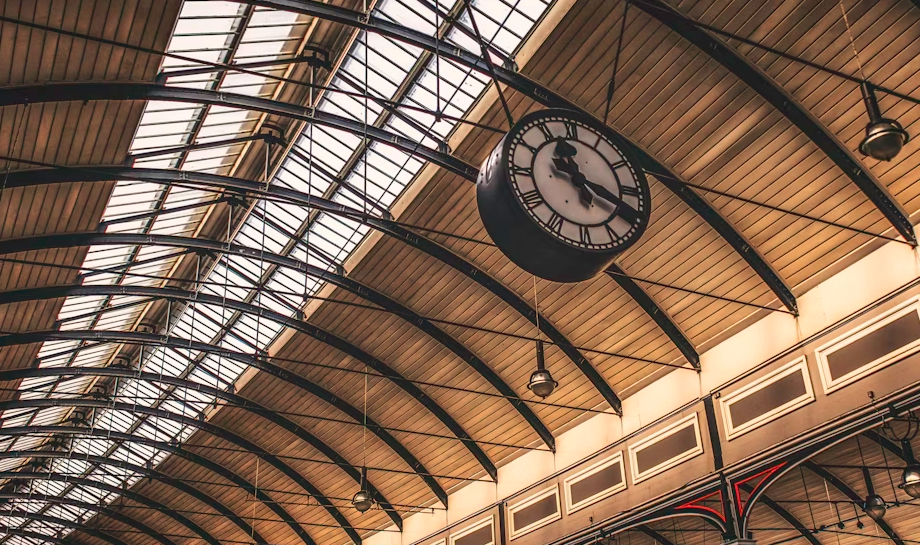
That curving train shed of the station was pretty much the first major British example of an iron-ribbed roof that curved like that. They used a mix of wrought-iron ribs and timber and iron purlins to span the platforms without needing loads of columns inside. That was a pretty clever way of doing things for the time.
The station also had gas lighting throughout – which not only made it a real showstopper at night but also helped make it safer and meant trains could run for longer. Original signalling was pretty basic, using mechanical lever frames and some visual signals which were coordinated from early cabins at the approaches to the station.
And finally, there was the iconic porte-cochere – that fancy stone bit that sticks out towards Neville Street – that was added later in 1863. It created a nice dignified space for carriages to pull up, which was exactly what Dobson had in mind to act as a kind of transition between the city and the railway.
Architectural Character and Engineering – an “Engineering Cathedral”
Newcastle Central station is more than just a key transport hub, its a carefully thought out bit of architecture and engineering that deserves to be appreciated as such.The Neville Street frontage looks stunning with a grand Romano-Italian sandstone façade that boasts ordered classical arches and pilasters. You get a glimpse of the grandeur of the place when you see the grand porte-cochère – a covered forecourt that acts as a kind of gateway between the hustle and bustle of the city centre and the industrial drama of the platforms that just wait for you.
Inside, the great curving train shed does serve as a big nave – it is visually striking with iron ribs arcing overhead like the structural ribs of a vault and the glazing lets just the right amount of daylight in. You can see why people have compared it to a cathedral, it’s a comparison that has been around since the Victorian era & not just because of its grand architecture & design.
The practical engineering here is seriously impressive:
- The curved ribs which are fixed to the masonry walls follow the track geometry rather than forcing unnatural straight lines everywhere
- Tie-rods and bracing stop the lateral thrust in its tracks
- Cast-iron columns at concourse edges help support the roof transition
The way the station is laid out shows its dual character – it is both a monumental public concourse and some more workmanlike service spaces – offices, parcels rooms and the undercroft below its all very impressive.
The involvement of top neville street architects and engineers around the station is just another example of the city’s broader architectural culture during its Victorian expansion.
The Hidden Station: Undercroft, Signalling and Substructure
You’d never guess that much of Newcastle Central’s engineering lies below our level of vision, in undercrofts, retaining structures and signalling installations that most passengers never have the chance to see.
The station sits on sloping topography that descends towards the River Tyne. This geographic condition really forced the engineers to think outside the box – or in this case – create a complex three-dimensional solution. Deep foundations on the south side and substantial retaining walls on the north really turn the station into a kind of inhabited viaduct.
Platforms were exactly 15 inches above rail level – a modest spec that shows Victorian precision in balancing passenger accessibility with mechanical clearance requirements.
Signalling has evolved significantly over time. Early local signal boxes used mechanical lever frames. The 1988-89 remodeling linked to East Coast Main Line electrification moved control to the Tyneside IECC. Historic features such as the once-famous diamond crossing east of the station where converging routes interlaced in intricate trackwork, were later simplified.
Modern day passengers benefit from the station management centre coordinating operations but they rarely see these critical spaces for themselves.
Growth, Bridges and Urban Integration (1860s – 20th Century)
As traffic grew in the late 19th century the station expanded. It grew from six platforms in the 1860s to around fifteen by the 1890s, with extended trainsheds, new bay platforms at the east end, and expanded concourse areas including “Tynemouth Square.”
Two bridges have transformed how trains approach:
- High Level Bridge (1849): Robert Stephenson’s combined road-rail structure, which allowed direct approach from the south
- King Edward VII Bridge (1906): Which allowed north-south through running without reversal
Closure of other termini, including New Bridge Street in 1909 cemented Central as Newcastle’s single dominant mainline station. Transport flows – taxi rank, tram routes, and later bus and Metro services all clustered around the portico.
Streets, hotels and commercial buildings all fanned out from the station, which acted as both a physical and economic anchor for the surrounding cityscape. The station’s visual dominance in views from the Tyne bridges made it an industrial landmark alongside churches and civic buildings.
The Roof and Recent Conservation: Traditional Craft in a Modern Station
Keeping a 19th-century iron and glass roof in one piece while running a 21st-century railway is no easy task.
The original 1850 trainshed construction used wrought-iron arches, timber elements, cast-iron columns at concourse edges, and traditional leadwork with glazing over multiple bays.
Recent roof restoration works followed careful principles:
- Striping and reinstatement of the original lead sheet
- Repair and strengthening of iron ribs
- Upgrading glazing for weather performance without losing its historical appearance
- Traditional leadwork techniques: bossing, welding and stepped lap joints
Given the logistical challenges, the conservation work took place above live platforms and overhead line equipment. Phased scaffold decks, night-time possessions and close coordination with train operators were all part of the mix.
This specialist conservation work connects to the expertise of contemporary newcastle architects, conservation engineers and craftspeople. The city maintains its role as a centre of architectural and engineering skill, just as it did when Dobson and Stephenson collaborated in the 1840s.
Newcastle Central in the 21st Century: Services, Facilities and Redevelopment
Today, Newcastle Central is the largest railway station in North East England, handling millions of passengers every year.
Mainline services doing the rounds include:
- London North Eastern Railway to London King’s Cross and Edinburgh
- CrossCountry to Birmingham and the South West
- TransPennine Express to Manchester and Liverpool
- Northern regional services
- Lumo low-cost servicesThe Tyne & Wear Metro link under the station’s concourse is a game changer for commuters – it opens up a world of possibilities to the Airport, South Shields, South Hylton and the coast – which only deepens the station’s importance as a key regional transport hub.
The first things you’ll notice on arrival are the staffed ticket office and travel centre, a fantastic passenger assistance lounge for people with disabilities, a rather posh first class lounge with newspapers and refreshments, and a range of accessible toilets including those with the national key scheme and Changing Places facilities. You can get in and out of the station easily thanks to step free access via lifts, or if you’re feeling a bit more energetic there’s also cycle parking and a car park to choose from.
Station staff are more than happy to lend a helping hand with getting on or off the train, and you can also get help with buying tickets and planning your journey from the customer information point on the main concourse.
How the Station Shaped the Victorian City
The station’s position and design really did turn Newcastle’s geography on its head back in the 19th century.
By aligning the station with the edge of the Tyne, it created a straight shot to Neville Street and the old town – this effectively drew all the commercial activity out west from the medieval centre. Even the modern taxi rank we see today has its roots in the old carriage stands that used to cluster around Dobson’s portico.
As you’d expect, all sorts of new buildings sprang up around the station – hotels, warehouses and offices all needing quick access to the trains to get their guests, goods and top executives to and from. And of course you can’t miss the iconic curved roof which has become such an iconic part of the Newcastle skyline – a real feature alongside the Tyne bridges and some of the city’s other grand buildings.
If you want to understand just how 19th-century Newcastle became the industrial, commercial and cultural powerhouse it was – then learning about the station’s engineering is a must.
Visiting Newcastle Central: Tips for the Modern Traveller
Newcastle Central station is one of those places that’s as useful for getting around as it is a fascinating piece of history to explore in your spare time.
Arriving at the station:
- Take in the main entrance on Neville Street which is clearly signposted to all the platforms
- For quick transfers across the city and to the Airport you can head down to the Metro without a fuss
- If you’re off to meet someone arriving on a train then you’ll find useful information on the travel centre
Getting in the zone:
- Take a peek up at the roof to see the beautiful ironwork
- Step outside to have a look at the grand porte-cochère
- And be on the look out for any surviving details of the original Victorian build – you might just spot some in the stonework, ironwork columns and signage
We’re working hard to make the station as accessible as possible – lifts take you to all the platforms, and station staff are always happy to help with turn up and go assistance – though if you know you’re going to need a bit of help, advance booking with passenger assist is always a good idea.
Peak times are pretty busy, especially during morning rush hour and when there’s a big match on at St James Park – but if you’re looking to take some photos then consider coming during a quieter time. The best thing to do is combine a visit to the station with a trip to some of the other local landmarks – like the Tyne bridges, Grey Street and the Castle – and you’ll get a real feel for the city’s amazing urban landscape.
Frequently Asked Questions
Can you have a mooch around the station even if you’re not planning to travel?
Yes you can! The station concourse and circulation areas are normally open to the public without a ticket, and you can pop in to admire the architecture and do a bit of shopping or grab a coffee while waiting for someone to arrive. Just keep in mind that you’ll need a ticket to get down to the platforms – and do check the security arrangements on the train operator’s website before planning a special visit.
Can you do a guided tour of the station and its history?
While there isn’t always a regular public tour – there are sometimes local heritage groups and railway societies who put on guided walks around the station and the surrounding area. You might also be able to find a walking tour of Grainger Town or railway heritage in Newcastle which includes the station – the local museums and heritage groups often put on special events, especially during heritage open days.
How does Newcastle Central link to the Tyne & Wear Metro and local buses?
Well, the Metro station is right beneath the mainline concourse – linked by escalators, lifts and stairs, so it’s really easy to transfer between the two. And if you do need to get the bus or a taxi, you can find the bus stops and taxi rank right outside on Neville Street. Just be aware that at busy times you might want to leave a bit more time for interchanges.
Is there somewhere to stash your luggage or bikes?
There might be a staffed left-luggage or locker service available – have a look on the station’s information pages for the exact details on cost and opening hours. And if you are bringing your bike, you can find secure, sheltered cycle parking around the station – just be sure to bring your own robust locks and check the rules on time limits and access restrictions.
What sets Newcastle Central apart from other Victorian railway stations?
Well, there are a few things that make it stand out – the Grade I-listed iron trainshed, the huge and impressive urban frontage by a local legend, and the clever way it integrates with the river bridges and city streets are just a few. And then of course there’s the way it all came together in a bit of a scramble early on – a proper feat of engineering. And we’re working hard to keep the historic fabric alive through conservation – it’s a really special place.

