
As embodied AI models continue to advance at remarkable speed, one challenge has become increasingly important: determining how well these systems actually perform in realistic environments.
While many models can demonstrate impressive results in controlled demonstrations, evaluating their capabilities consistently remains difficult. Differences in environments, tasks, datasets, hardware, and testing methods can make it challenging to compare models fairly or understand where their real strengths and weaknesses lie.
To address this challenge, RoboColiseum, a standardized simulation evaluation platform for embodied intelligence, has officially launched. The platform provides a structured, multi-dimensional evaluation framework designed to connect simulation performance with real-world robotic capabilities.
RoboColiseum enables universities, research institutions, AI companies, and individual researchers worldwide to train, test, and compare embodied AI models through standardized simulation benchmarks. By providing detailed evaluation results and continuously updated benchmarks, the platform aims to make embodied AI evaluation more reliable, transparent, and reproducible.
Since entering its closed beta phase, RoboColiseum has already attracted hundreds of teams worldwide to train and evaluate their models.
Learn more about RoboColiseum: http://robocoliseum.ai/
Connecting Simulation Performance With Real-World Robotics
One of the biggest questions in embodied AI is whether success inside a simulated environment accurately reflects performance on a physical robot.
The transition from simulation to the real world is rarely straightforward. Real robots must operate under constantly changing conditions. Lighting can vary, objects can have different material properties, cameras can introduce noise, and objects may behave differently during physical interaction. Even small changes in a robot’s starting position or orientation can affect the outcome of a task.
These challenges make reliable simulation-based evaluation essential for modern robotics research.
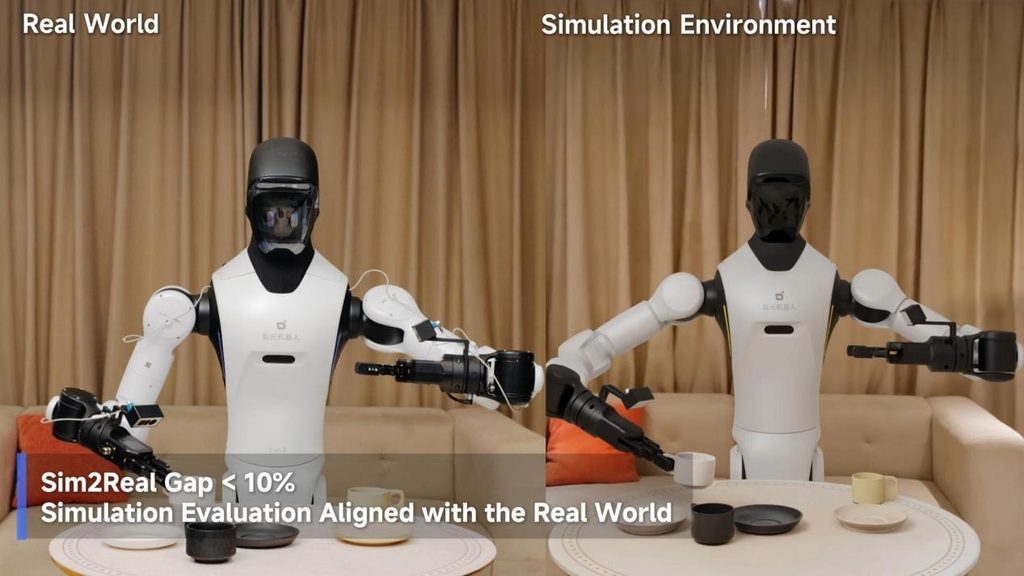
RoboColiseum is built around a high-fidelity simulation environment designed to reproduce real-world conditions as accurately as possible. The platform combines photorealistic rendering with physically accurate interactions to create testing environments that more closely resemble physical robotic scenarios.
According to the platform, the observed sim-to-real performance gap is below 10% for its evaluation framework. This makes simulation a practical proxy for physical robot testing while potentially reducing the time, computing resources, and hardware requirements associated with repeated real-world experiments.
Instead of moving every model directly onto physical robots for initial testing, developers can first evaluate their systems in simulation, identify problems, and make improvements before conducting real-world validation.
This creates a more efficient development cycle:
Training → Evaluation → Improvement → Deployment
The approach also works in reverse. Models trained using real-robot data can be evaluated in simulation, while simulation-trained models can subsequently be tested on physical robots to determine how effectively their capabilities transfer to real environments.
By bringing these two sides together, RoboColiseum aims to make the relationship between simulation and physical robotics easier to measure and understand.
A Four-Dimensional Framework for Understanding Model Capabilities
A single success-rate number rarely tells the complete story of an embodied AI model.
Two models may achieve similar overall scores while having very different capabilities. One might be better at following instructions, while another could have stronger spatial reasoning or manipulation skills.
RoboColiseum addresses this issue by evaluating models across four major capability areas:
- Instruction Following
- Spatial Reasoning
- Robustness
- Manipulation
The platform currently includes four capability-specific leaderboards and 78 high-fidelity simulation evaluation tasks, allowing developers to examine both overall performance and individual task results.
This granular approach is intended to help researchers identify exactly where a model performs well and where additional development is needed.
Instruction Following
Instruction following measures how effectively a robotic model understands and executes natural-language commands.
Tasks can involve characteristics such as an object’s color, shape, size, position, or logical relationships. The objective is not simply for the robot to perform an action, but to ensure that the action accurately reflects the instruction it received.
This capability is particularly important as natural-language interfaces become increasingly common in robotics.
A model may need to understand commands that require several pieces of information and translate those instructions into appropriate physical actions. RoboColiseum’s instruction-following evaluations are designed to measure how closely the robot’s behavior matches the requested objective.
Spatial Reasoning
Robots must understand their surroundings before they can interact with them effectively.
RoboColiseum evaluates spatial intelligence through tasks involving activities such as relative-position grasping, object sorting, and stacking.
These scenarios require models to combine geometric understanding with semantic reasoning. A robot may need to identify an object, determine its position relative to another object, and then select the correct action based on the instruction.
Testing these capabilities independently gives developers a clearer picture of how effectively their models understand and reason about physical environments.
Robustness Under Realistic Disturbances
Real-world environments are unpredictable.
A model that performs perfectly in a fixed laboratory setup may struggle when lighting changes, the camera introduces noise, the background looks different, or an instruction is phrased in an unfamiliar way.
RoboColiseum therefore evaluates robustness under more than 10 types of real-world disturbances.
These include changes in:
- Lighting conditions
- Background environments
- Instruction wording
- Camera noise
- Gripper configurations
- Other environmental and robotic variables
By introducing controlled variations into evaluation scenarios, the platform can test whether a model has learned transferable capabilities or simply adapted to a narrow set of conditions.
This is especially important for developers seeking to deploy embodied AI systems beyond carefully controlled demonstrations.
Measuring Manipulation Skills
Manipulation represents another core area of robotic intelligence.
RoboColiseum evaluates a range of fundamental manipulation abilities across different scenes and difficulty levels. These atomic skills can then be combined into longer-horizon tasks that require a model to perform multiple actions in sequence.
This tiered structure makes it possible to examine both individual abilities and the model’s capacity to combine those abilities into more complex behavior.
For example, a model may successfully perform a basic grasping action but struggle when grasping becomes one step in a longer sequence involving multiple objects and decisions.
Breaking manipulation into different levels allows developers to see where these failures begin.
Detailed Evaluation Makes Failures Easier to Diagnose
Knowing that a robot failed is useful. Knowing why it failed is much more valuable.
RoboColiseum addresses this by dividing evaluation tasks into multiple subtasks. Rather than reporting only whether the final objective was achieved, the platform records the progress made throughout the task.
Developers can determine:
- Which subtasks were completed successfully
- Where the model encountered problems
- Which actions caused the final failure
- How performance changes across different scenarios
- Whether the model can generalize beyond familiar conditions
This makes evaluation more actionable.
Instead of simply learning that a model achieved a particular success rate, researchers can use task-level information to identify specific weaknesses and target them during the next training cycle.
Improving Reproducibility Through Diverse Testing
Reproducibility is a major consideration when comparing AI systems.
If models are repeatedly evaluated using identical layouts or predictable scenarios, performance can potentially be influenced by memorization or overfitting to specific environments.
RoboColiseum uses large-scale and diverse samples to reduce the influence of randomness and fixed patterns.
The platform incorporates techniques such as domain randomization, separate training and testing sets, and both in-distribution and out-of-distribution evaluations.
These approaches are intended to ensure that models are assessed according to their actual capabilities rather than their familiarity with a particular environment.
As a result, developers can obtain evaluation results that are more consistent and meaningful when comparing different models.
Submit a Model and Begin Evaluation in Minutes
Building an evaluation environment from scratch can be a significant undertaking.
Researchers may need to configure simulation environments, adapt assets, integrate models, manage computing resources, and develop evaluation scripts before they can even begin testing.
RoboColiseum aims to simplify this process through an automated evaluation service.
According to the platform, developers can register and submit a model in as little as five minutes, deploy it with one click, and complete simulation evaluation in approximately 30 minutes.
After evaluation, the platform provides detailed results, including scores, task-level performance, and model execution videos.
These resources allow developers to see not only the final score but also how their model behaves while completing individual tasks.
AI Agents Simplify the Evaluation Workflow
RoboColiseum also incorporates AI Agent capabilities into the development workflow.
Developers can use natural-language interaction to handle activities such as downloading data, training models, performing local validation, and submitting evaluations.
The platform does not require developers to upload their model code and weights directly.
Instead, developers can deploy an inference service within their own environment and connect it to RoboColiseum through a standardized interface.
This approach can give research teams greater flexibility while simplifying the process of connecting existing models to the evaluation platform.
Benchmarking Against Leading Embodied Foundation Models
Reliable benchmarking becomes more useful when researchers have strong reference points.
RoboColiseum provides baseline evaluation results for several recognized embodied foundation models, including ACoT-VLA, π0, π0.5, and GR00T.
Developers can submit their own models and compare their results with these established systems across the platform’s four evaluation dimensions.
This allows researchers to quickly determine whether a new model has achieved competitive performance and identify the specific capabilities where it stands out or falls behind.
The baseline results can also provide useful targets for future development.
Reproducible Training and Evaluation
Benchmarking is most valuable when researchers can reproduce the underlying results.
To support this goal, RoboColiseum provides training code and corresponding model weights for baseline models used on platform tasks.
Researchers can reproduce training procedures, conduct their own evaluations, verify baseline results, and perform comparisons under consistent conditions.
This creates a more controlled environment for research and makes it easier for different teams to build upon previous work.
Instead of each research group developing its own evaluation methodology, standardized benchmarks can provide a common foundation for experimentation.
RoboColiseum as an AI “Arena” and “Training Ground”
The name RoboColiseum is inspired by the ancient Roman amphitheater.
The concept reflects the platform’s broader purpose.
On one side, RoboColiseum acts as an arena, where different embodied AI models can compete under standardized conditions.
On the other, it functions as a training ground, where developers can repeatedly evaluate their systems, discover weaknesses, improve their models, and test those improvements.
This distinction is important because evaluation should not be treated as the final step of development.
Instead, it can become part of an ongoing improvement loop.
A developer can train a model, evaluate it against standardized tasks, analyze its failures, modify the model, and run the evaluation again. Over time, this process can create a measurable path toward better robotic intelligence.
Toward More Reliable Embodied AI Progress
Embodied AI is moving from controlled demonstrations toward increasingly complex physical applications.
As this transition continues, standardized evaluation will become increasingly important.
A model that succeeds in a carefully selected demonstration does not necessarily possess robust general-purpose capabilities. Real-world deployment requires systems that can understand instructions, reason about physical environments, manipulate objects, and continue functioning when conditions change.
RoboColiseum aims to address these challenges by turning complex robotic scenarios into standardized, reproducible, and continuously evolving evaluation tasks.
Its broader objective is to make evaluation a fundamental part of embodied AI development rather than an afterthought.
Creating a More Open Robotics Ecosystem
RoboColiseum is also designed around collaboration.
The platform welcomes universities, research organizations, AI companies, and individual developers from around the world. Developers are encouraged to contribute their models and participate in building a broader open ecosystem for embodied intelligence.
By allowing different systems to be evaluated under comparable conditions, the platform can help researchers understand how approaches differ and where further progress is needed.
Open participation can also encourage greater collaboration between academic researchers and industry teams.
Moving Beyond Carefully Selected Success Cases
The development of embodied AI has produced many impressive demonstrations, but demonstrations alone cannot provide a complete picture of a model’s capabilities.
A more mature field needs consistent measurements.
RoboColiseum’s approach is designed to shift attention from isolated success cases toward repeatable, measurable, and verifiable performance.
With multiple capability dimensions, dozens of simulation tasks, robustness testing, detailed failure analysis, and baseline comparisons, the platform provides developers with a broader framework for understanding embodied AI systems.
The goal is not simply to determine which model achieves the highest score.
It is to understand why a model performs the way it does, where it succeeds, where it fails, and how those findings can guide the next generation of development.
RoboColiseum Is Now Open
RoboColiseum has officially opened its platform to developers and researchers worldwide.
By combining high-fidelity simulation, standardized benchmarks, multi-dimensional evaluation, automated testing, baseline models, and reproducible research workflows, the platform aims to provide a common foundation for the rapidly evolving embodied AI community.
As robotic foundation models become increasingly capable, platforms that can measure their performance consistently will play an important role in determining how quickly these systems can move from promising research demonstrations to dependable real-world applications.
RoboColiseum’s long-term vision is to help create that measurement infrastructure while giving developers a place to test, compare, learn, and improve.
Explore RoboColiseum: http://robocoliseum.ai/

