
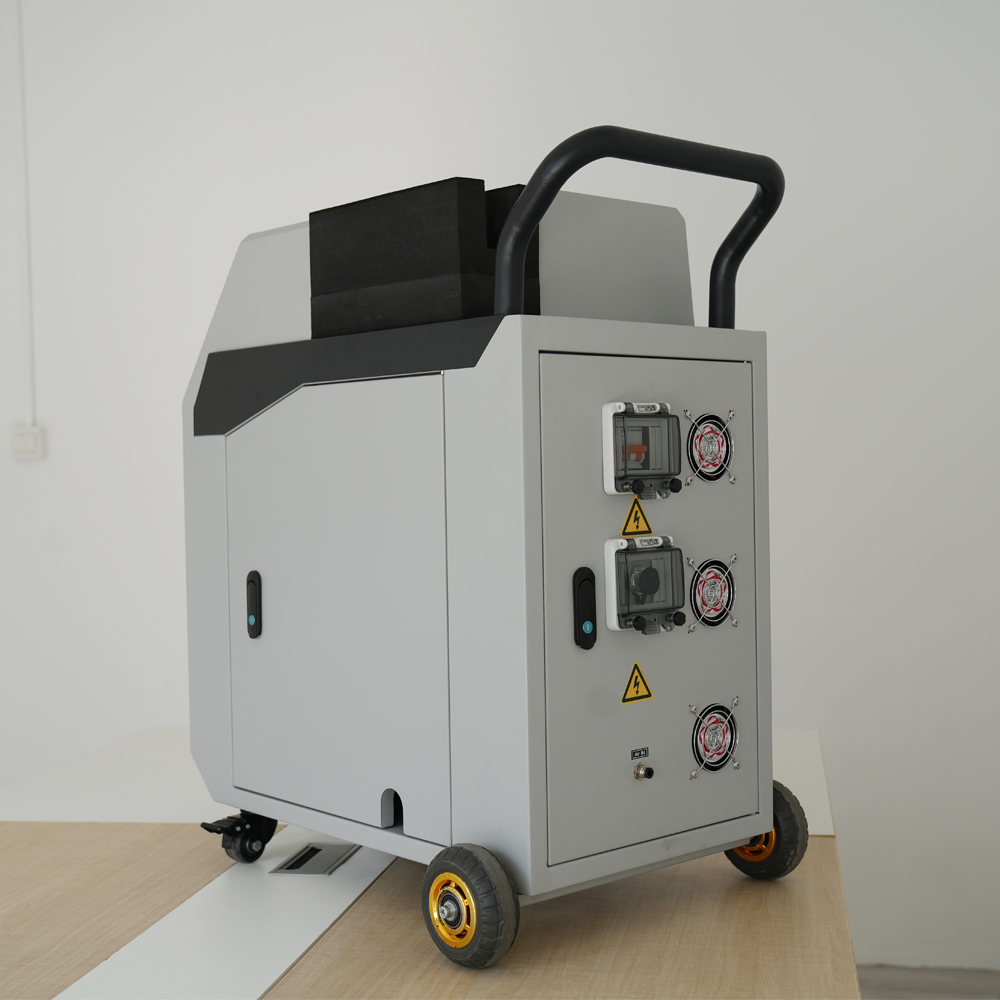
Choosing how to clean a metal surface is rarely just a technical decision. It also affects cost, waste, safety and the quality of the part afterwards. Traditional methods such as abrasive blasting and chemical cleaning have served industry for a long time. Newer equipment such as an air cooled pulse laser cleaning machine offers a different path. This article compares them fairly, using the points published by HS Laser, and also notes where traditional methods still make sense.
How abrasive blasting works
Abrasive blasting throws particles at a surface at high speed to knock off rust, paint or scale. It is fast on large, tough surfaces and has been used for decades. The drawbacks are also well known. The blasting media has to be collected and separated from the removed paint, which creates disposal costs. Particle impact can also damage thin or soft materials.
HS Laser points out that laser cleaning avoids the disposal problem because no media is used. It describes laser cleaning as a controlled, non abrasive process that avoids accidental surface damage and is suitable for thin and composite materials that cannot take particle impact. It also says results are consistent regardless of operator skill and that the job size can be matched by choosing the right laser power.
How chemical cleaning works
Chemical cleaning uses solvents or other liquids to dissolve contamination. It is good for cleaning whole parts, for example by immersion. The company notes that it is not easily applied to a selected area.
Disposal is the other challenge. The product page says that disposing of chemicals is an increasingly difficult and costly task because of regulatory controls. Chemicals can also change with use, which may affect consistency. Laser cleaning, by contrast, has no chemical solvents to dispose of, can be applied selectively and leaves parts available at once because there is no drying time.
Where laser cleaning has the edge
Based on the information the company provides, the main advantages are as follows. It is a non contact process, so there is no wear on the part from particles or brushes. It uses no consumables like abrasives or solvents, which the company says lowers operating costs and environmental impact. It is selective, so you can clean only the area you need. It is controllable and repeatable, and it can be automated for consistent results.
The machine itself is also designed to be simple. The model on this page is handheld, air cooled and portable, with a total machine weight of 56 kg and a cleaning head weighing 0.7 kg. The company describes it as plug and play, with manual focus adjustment and an intuitive interface.
Where traditional methods still win
An honest comparison must include the other side. Laser cleaning machines cost more to buy than basic blasting equipment, and large, heavily corroded surfaces may take longer to clean with a low power laser than with blasting. If you only clean occasionally, or if the surface is very large and rough, blasting or another established method may be more practical.
Chemical cleaning remains useful for removing certain kinds of contamination from complex internal shapes where a laser beam cannot reach, since a laser needs line of sight to the surface.
The right choice depends on the part, the contamination, the volume and your budget.
Power matters
Laser cleaning is not one size fits all. This product page lists models of 200W, 300W and 500W, with a 1000W option mentioned in the header. Pulse energy options run from 1.5 mJ to 50 mJ. Light dust and thin oil film call for less energy, while thick rust or multiple paint layers call for more. Ask the supplier to match the power to your actual work, and avoid paying for more than you need.
Safety and the work environment
Lasers need proper precautions. Operators must wear eye protection suited to the laser wavelength, which for this machine is 1064 nm, and should receive training. Fumes from vaporized coatings may need extraction, depending on what is removed. Blasting and chemical cleaning have their own safety needs, including dust control and chemical handling, so every method asks for care.
Counting the real cost
When you compare methods, look beyond the purchase price. Add the cost of consumables, waste disposal, labor, rework, downtime for drying or cleanup, and any damage to parts. The company argues that laser cleaning has lower running costs because it uses no abrasives or chemicals. Whether that is true for you depends on how often you clean and how much you currently spend on media, solvents and disposal. Do the arithmetic with your own numbers.
Make a test before you decide
The best way to compare is to try. Send a few of your actual parts, with their typical rust, paint or oil, and ask for cleaning samples and photos. Check the surface afterwards for cleanliness and damage. When the results are clear, the decision usually becomes easy.

